
Introduction to BIM Methodology
17 April 2017 by Lisgrett Bellorin
What Is BIM?
Construction project management demands methodologies that drive efficient resource use and provide fast, interactive access to information.
Building Information Modelling (BIM) meets both requirements by enabling the real-time generation and management of a building's data within a single, centralized model.
BuildingSMART, the international authority on open BIM standards, defines it this way:
"A collaborative working methodology for the creation and management of a construction project. Its goal is to centralize all project information in a digital information model built by all project stakeholders. BIM represents the evolution beyond traditional drawing-based systems by incorporating geometric data (3D), time (4D), cost (5D), environmental performance (6D), and maintenance (7D). BIM extends well beyond the design phases, covering project execution and continuing throughout the building's lifecycle — enabling ongoing asset management and reducing operational costs."
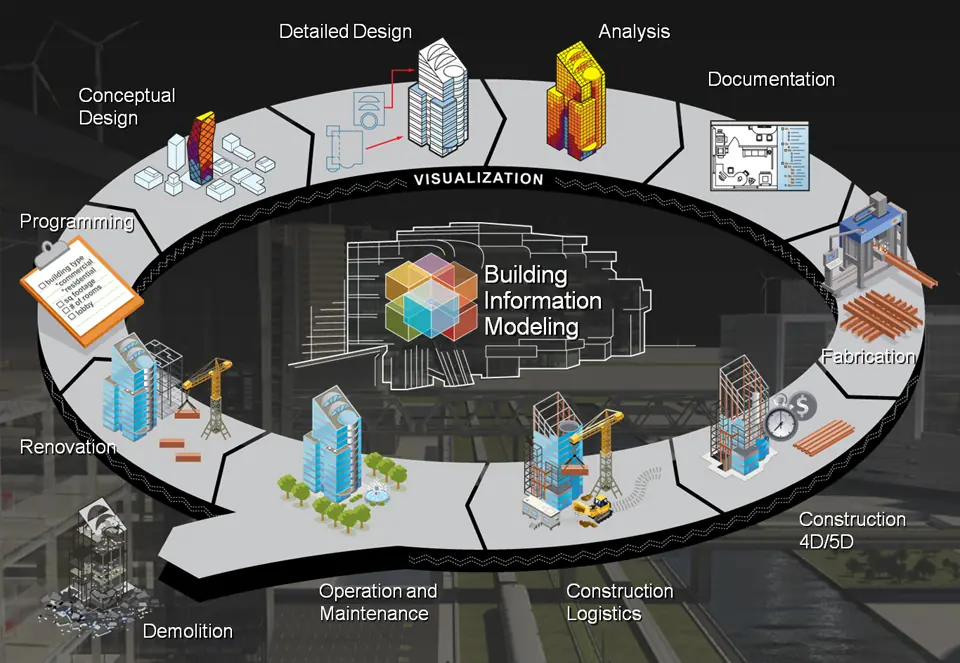 A BIM model applied to construction project management.
Teams adopt BIM for many reasons, but the most common starting point is the need to present clients with rich 3D visualizations of a proposed building. The value runs much deeper than that, however.
Because all data lives in a single shared model, any design change — whether architectural or within a specialist discipline — propagates automatically across every view. The model stays current in real time, which accelerates documentation and provides built-in quality assurance through automatic coordination between disciplines.
BIM models also go far beyond architectural geometry. They carry engineering data, structural load information, duct and pipe routing, and sustainability metrics, making it possible to simulate building performance long before construction begins.
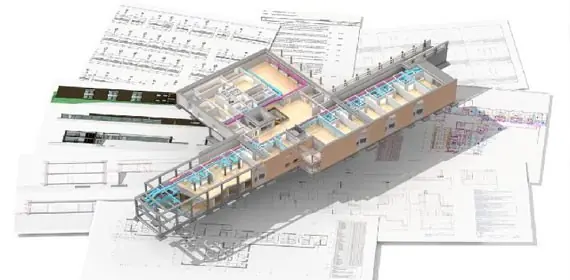 BIM integrates architectural, structural, MEP, and sustainability data into a single model.
BIM also captures information that traditional CAD drawings simply cannot hold: schedule management, human and technical resource allocation, material tracking, and other variables that affect the project timeline.
Budget management is equally embedded in the model, with cost data tied to each project phase. Crucially, none of this stops at handover — all data embedded in the BIM model remains available throughout the building's operational life, directly supporting cost-effective facility management and maintenance planning.
Taken together, these capabilities position BIM as an information management system that underpins better decisions at every stage of a project, always grounded in the highest-quality data available.