
LEED: Best Practices in Projects
4 November 2016 by Maria Paolini
LEED is an evaluation program that brings together a range of measures designed to incorporate sustainable attributes into construction projects.
Here are some of the strategies applied through LEED certification — ones worth keeping in mind regardless of a project's scale or complexity.
Construction Site Impact Control
From the moment a project breaks ground, minimizing environmental impact should be a priority. A perimeter barrier is essential to prevent dust from spreading beyond the site, and truck exit points require attention: tires must be cleaned before vehicles reach public roads to avoid tracking mud and sediment onto surrounding streets.
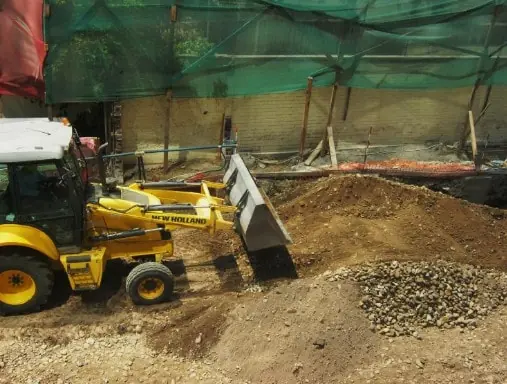 Dust and sediment control at a construction site perimeter.
Earthworks during foundation excavation must be managed carefully to preserve the quality of non-buildable soil and mitigate erosion. The same applies to groundwater and any drainage channels adjacent to the site, where sediment control measures are required. In both cases, strategic use of vegetation can significantly reduce the project's environmental footprint.
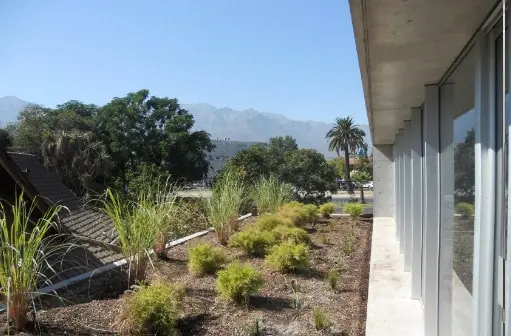 Erosion control during the foundation excavation phase.
Green Area Design
Thoughtful landscaping goes well beyond aesthetics — it can meaningfully improve a project's overall performance. A well-designed green area reduces water consumption, simplifies plant maintenance, and lowers the risks associated with pesticide and fertilizer use.
Practical recommendations include:
- Select native or climate-adapted species.
- Avoid turf grass, which demands significant water volume.
- Install an efficient irrigation system.
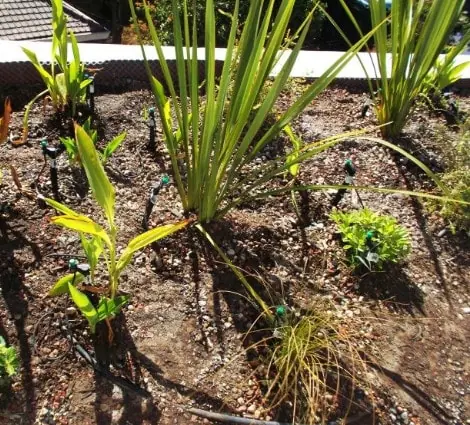 Native-species landscaping with low-consumption irrigation.
Energy Efficiency and Automation
One of the most effective ways to reduce energy demand is through building control and automation systems. These allow equipment to be scheduled and system operation to be verified with precision.
In larger, more complex projects, tracking meter readings across multiple systems can be a real challenge. Monitoring devices are invaluable here — they catch faults early and enable timely corrections before small inefficiencies compound into significant energy losses.
Waste Reduction
Recycling is worthwhile, but it requires collection effort and infrastructure. A more direct approach is reducing waste at the source.
Cutting back on printing — or reusing printed sheets as scratch paper — is a straightforward example. The underlying principle is worth keeping front of mind: reduce first, reuse second, recycle as a last resort.
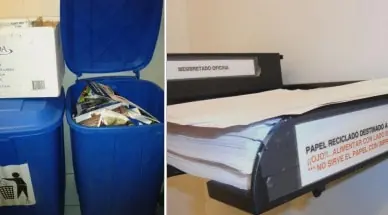 Waste management guided by the reduce, reuse, recycle hierarchy.
Indoor Environmental Quality
Maintaining adequate ventilation rates alongside appropriate lighting levels is fundamental to occupant comfort — and comfort has a measurable effect on both health and productivity.
An automation system can reliably deliver the required airflow and maintain proper illumination. Natural daylight deserves particular attention: it improves occupants' wellbeing and reduces the energy load from artificial lighting. Designing for daylight access is one of the highest-return moves in the LEED toolkit.
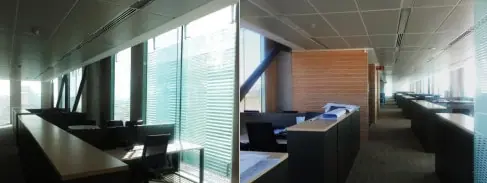 Natural light as a tool for occupant comfort and energy efficiency.
My hope is that these practices serve as a practical entry point into sustainability — and that LEED certification comes across for what it is: a workable framework with tangible results, scalable to projects of any size. The scope and cost of the strategies involved will vary depending on the project's needs and the sustainability targets it sets out to meet.