
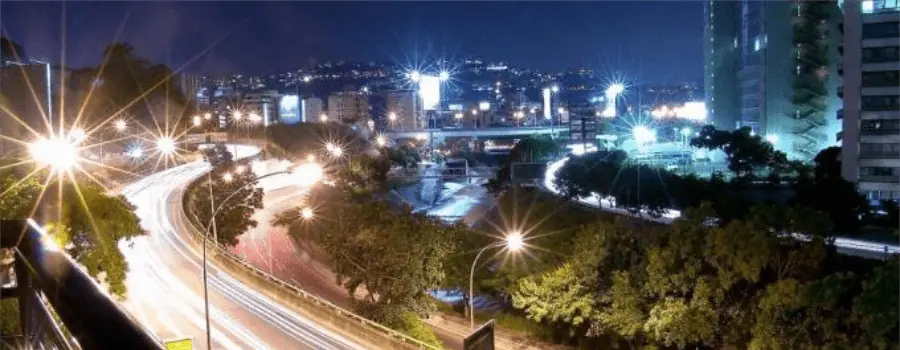
Automation and Control for Public Street Lighting
3 October 2016 by Carlos Dobobuto
Governments are responsible for delivering a broad set of essential services to their citizens: healthcare, security, water supply, energy, street lighting, transportation, communications, and waste collection, among others.
Every single one of those services depends on one common input — electricity. Without it, practically nothing else functions.
Climate change, natural disasters, underinvestment in energy production or distribution, and widespread energy waste can all disrupt supply to entire communities or cities. Venezuela experienced a stark illustration of this not long ago, when power had to be cut for entire days at a stretch.
Rather than dissect the causes of that crisis — which risks sliding into unproductive criticism — this post uses it as a starting point to raise awareness about a problem that receives far too little attention: the role of public street lighting in urban energy consumption.
Street lighting is the single largest energy consumer among municipal services (outside electricity used in public buildings themselves). The majority of fixtures in use are 400 W sodium-vapor or mercury-vapor lamps, followed by 250 W units of the same type, with LED-based low-consumption fixtures making up a smaller share.
The two most persistent problems with these networks are vandalism against the physical infrastructure and lack of control over on/off scheduling. To put the scale in concrete terms: three 400 W fixtures left on during daylight hours consume enough power to cut electricity to one household (based on consumption bands set by the regulatory authority). Even more striking: 21 fixtures running just two hours off-schedule per day — one hour in the morning, one in the evening — produce the same effect.
Anyone who has driven through a city has seen entire streets, avenues, and highways with lights blazing in broad daylight. Often, those same fixtures aren't on at night, which makes the lack of operational control self-evident.
Scale that scene across every avenue in a country, and the aggregate cost — in wasted energy and households left without supply — becomes very large very quickly.
The Problem Isn't Always Mismanagement
That heading may spark debate, but it's worth stating directly: significant investments of money and time are often made in street lighting infrastructure. The problem is that those investments tend to repeat the same pattern of actions and, predictably, reproduce the same results.
Municipalities typically procure and install cabling, fixtures, distribution panels, timers, and occasionally photocells and isolated photovoltaic systems. What they rarely implement is any ongoing supervision or maintenance management.
That gap allows two failure modes to compound over time: vandals and saboteurs damage expensive infrastructure, and fixtures fail gradually with no tracking of which ones need replacement or where they are.
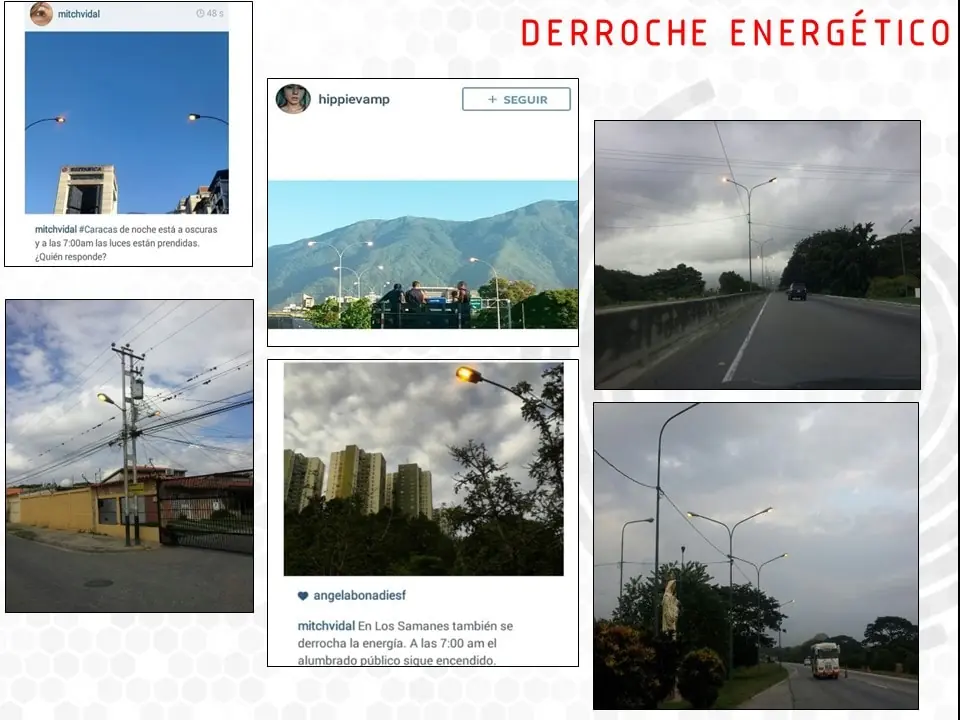 Conventional street lighting network with no remote control system.
A lack of familiarity with available technology — among infrastructure and technology directors at both national and regional levels — is likely preventing the adoption of solutions that already exist globally: solutions designed first to protect costly infrastructure, and second to guarantee efficient use of fixtures, which translates directly into efficient use of energy.
The standard method for counting failed fixtures across a city is to send crews out on nighttime drives through every street and avenue. We once met with the National Director of Street Lighting at the Ministry of Transport and Public Works, who described how — ahead of a presidential event scheduled on a major highway — teams had to conduct prior nighttime inspections of every fixture along the route to confirm it was working. On another occasion, we were told that a mayor in greater Caracas personally drove through neighborhoods at night to identify which streets had lighting failures.
There has to be a better path forward — one that breaks the cycle of spending repeatedly on the same streets and avenues and still ending up with the same unlit roads.
Integrated Solutions Built on Open Standards
A wide range of solutions exist for street lighting control, from traditional photocells and luminosity sensors to autonomous systems with photovoltaic panels and battery storage.
The problem is that most solutions deployed in practice are point solutions — they address one specific need while leaving a host of other requirements unmet. The same principle that drives integrated automation and control networks for large buildings or entire residential developments applies here: the answer lies in genuinely comprehensive solutions that account for all the variables involved in protecting and operating a street lighting network.
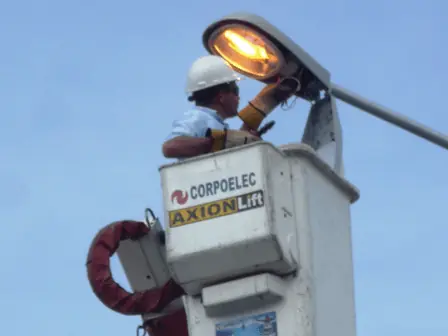 Isolated point solutions versus integrated lighting control: a comparison.
The market for integrated street lighting automation includes a variety of established manufacturers producing equipment capable of supporting diverse solution architectures. Protocol selection, however, deserves careful attention.
As in every technology domain, two categories of systems exist: closed systems, where the network owner is locked into exclusive contracts with a single vendor, and open systems, where no such exclusivity is required. The distinction has long-term financial and operational consequences that are easy to underestimate at procurement time.
Lighting Management and Integration Platform
Any solution designed for deployment at city scale should address:
- Physical security of the infrastructure.
- Optimization of energy consumption.
- Data generation to support predictive, preventive, and corrective maintenance.
- The flexibility to expand coverage incrementally as budget allows.
- Future integration with other urban subsystems — panic buttons, public security, traffic signals, digital signage, and irrigation systems.
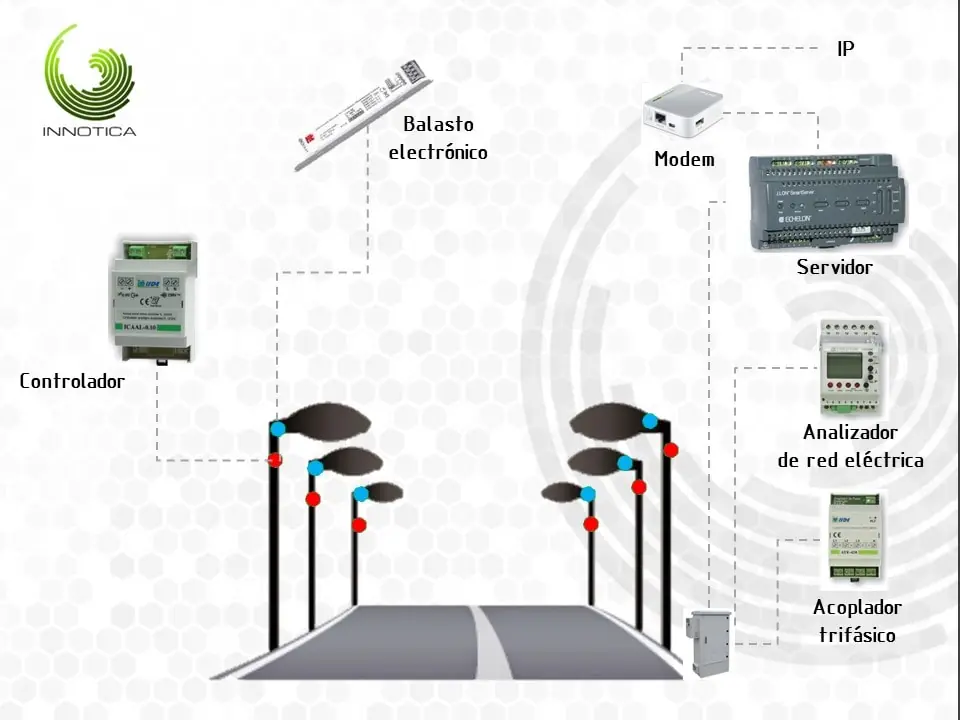
Implementing this type of network requires placing control devices in the distribution panel serving each lighting segment. For more robust deployments with broader application capabilities, individual network nodes are installed on each controlled fixture.
The core components include:
- A magnetic contact or tamper switch to detect unauthorized opening of the control panel (anti-vandalism).
- A network analyzer to monitor line status — detecting energy theft and generating alerts for abnormal electrical conditions.
- Three-phase couplers.
- A web server with an astronomical clock to manage scheduling for each segment.
- A modem for remote access to the controlled segment, via wireless (3G, LTE, or similar) or wired internet connection.
- At each fixture: a control node output port to execute commands on the lamp actuator, status monitoring for both the fixture and the cabling (vandalism detection), and a ballast to execute the final action on the lamp.
 Integrated automation and control network architecture for public street lighting.
With this infrastructure in place, control strategies can be defined to detect vandalism in real time and alert the operations director, law enforcement, or the local community — before damage is done rather than after.
The network makes it possible to identify unauthorized panel access, energy theft (unauthorized connections), cable theft, and fixture damage or removal.
On the energy side, scheduling strategies ensure that every fixture switches on and off at the right time, with light intensity regulated based on time-of-night schedules and user traffic analysis along each segment. This type of solution can deliver up to 35% reduction in energy consumption — a figure that becomes substantial when applied at national scale.
The supervision and control platform also provides a live view of the status of every lighting segment, end-of-life proximity alerts for fixtures, real-time energy consumption and savings reports, and additional functionality configured to meet each city's specific requirements.
 Public street lighting supervision and control platform.
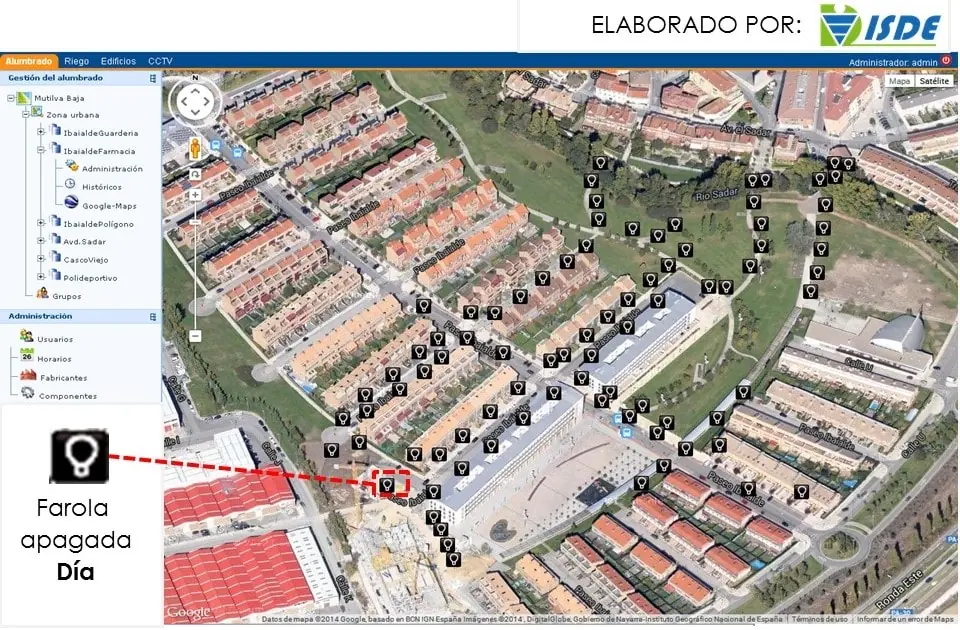 Courtesy of our advisor ISDE-ING.
Building this control infrastructure also creates the backbone for integrating other urban subsystems currently managed in isolation: traffic signals for improved mobility, public safety (where CCTV is typically deployed without coordination with other systems), digital advertising, water pumping and irrigation, and more.
Pilot Programs and Local Technology Development
Nationwide rollout of this type of network should be approached progressively, beginning with a pilot program that lets public officials evaluate the benefits, compare them against the investment, and model the economics of national-scale deployment.
Our calculations suggest that disciplined control of street lighting could free up enough capacity on the national grid to match the total electricity consumption of a large state — comparable, for reference, to Anzoátegui state, which recorded 4,469,169,510 kWh billed in 2013, according to the 2014 Energy Yearbook published by CORPOELEC.
 Projected energy savings modeled at national scale.
Choosing open standards — systems built on ISO-compliant protocols — prevents governments from becoming dependent on any single equipment vendor. More importantly, it creates conditions for universities and domestic companies to develop locally manufactured products that meet local demand and potentially supply neighboring markets across the region.
The opportunities are real. What they require is political will to plan, allocate budget, and at minimum commission a pilot that demonstrates what these systems can actually deliver.
 Local engineering talent has the capacity to develop homegrown technology for this sector.
I want to close by encouraging everyone to support the entrepreneurship and technical projects emerging from universities and domestic companies. There is enormous potential being lost as other countries attract the young professionals who could be building these solutions at home.
Local talent can do more than solve the street lighting problem — it can generate employment, generate export revenue, and create the kind of compounding opportunity that improves things for the next generation. Planning deliberately and eliminating improvisation: that has to be the goal we keep in sight.