
Climate Change and Sustainability in Building Design and Construction
16 September 2020 by José Solano
Climate Change and the Building Sector
The building sector — specifically energy-related operations — accounts for roughly 19% of global greenhouse gas (GHG) emissions, measured in CO₂-equivalent tonnes, according to the IPCC's Fifth Assessment Report (IPCC, 2014).
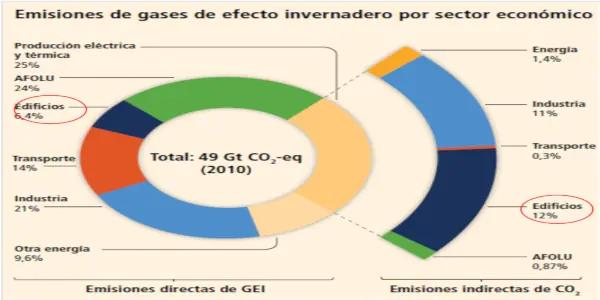 Global GHG emission trends associated with the building sector.
That energy use — and the emissions it drives — could double or even triple by mid-century, driven by several converging trends (Lucon et al., 2014). Chief among them: billions of people in developing countries are gaining access to adequate housing and electricity for the first time.
Population growth, urbanization, and shifting household sizes worldwide will further drive significant increases in construction demand and the energy that comes with it.
Sustainability in Building Design and Construction
Sustainability in design and construction means approaching buildings as a whole-system challenge. Access to decent housing is a human right, and guaranteeing adequate living and working conditions for everyone is a worthy goal — but it requires confronting the environmental implications head-on.
If we envision a world where all people live in residential buildings and work in offices or commercial spaces, the burden placed on our planet becomes undeniable. It is the planet that supplies construction materials, energy, water, and the capacity to absorb effluents, waste, and emissions. That ecological balance is easy to take for granted — until it breaks.
Applying the principles of precaution and prevention, sustainability must play a role from the earliest design stages through materials procurement, construction, operations, and maintenance. The goal is to optimize consumption of materials, water, and energy while maintaining minimum health and well-being standards for occupants throughout a building's useful life.
Over the past decade, a broad set of strategies and design principles have emerged, all aligned with the three core dimensions of sustainability: People, Prosperity, and Planet — also known as the Triple Bottom Line. These are embedded in best-practice guidelines and third-party certification schemes backed by accredited agencies and institutes.
The encouraging news is that cost-effective technologies and a substantial body of global experience already exist for implementing energy optimization strategies. These range from renewable energy integration and high-performance HVAC systems to low-consumption lighting and appliances, rainwater harvesting, and low-environmental-impact materials across their full life cycle.
The toolkit also includes low-VOC (volatile organic compound) materials to ensure healthy indoor environments — a consideration that has gained urgency in the post-COVID-19 era. All of these technical measures must go hand in hand with changes in lifestyle and behavioral patterns, supported by public education.
Zero-Energy and Zero-Carbon Buildings
This decade, widely called the "Decade of Action," began in 2020. There is no question we have reached an inflection point where critical decisions must be made to meet the targets set out in the 2030 Agenda and the Paris Agreement.
The working paper Tracking Progress of the 2020 Climate Turning Point (Ge et al., 2019) finds that the average global energy intensity of buildings (energy use per m²) must improve by 30% by 2030 to stay within the temperature limits set by the Paris Agreement. Achieving that will require zero-energy, near-zero-energy, and zero-emission buildings to become the standard for new construction this decade.
In early 2019, the World Green Building Council (WGBC, 2019) launched an ambitious initiative called the Net Zero Carbon Buildings Commitment, designed to recognize and accelerate climate leadership among companies, organizations, cities, states, and regions through the decarbonization of the built environment.
The initiative aims to maximize the chances of limiting global warming to less than 2 °C. Concretely, it targets zero operational emissions from existing buildings by 2030 and from all buildings by 2050, through high energy-efficiency strategies and 100% renewable energy. One important caveat: the commitment does not yet address embodied carbon — the emissions associated with the extraction and manufacture of construction materials.
 Decarbonization strategies for the built environment aligned with Paris Agreement targets.
Climate change presents a fundamental challenge to the integrated sustainability approach in building design and construction. Meeting it will require unified methodologies capable of assessing the full life cycle of a building and its supply chain — along with engineering standards and material practices that can guarantee pathogen-free indoor environments in an era when that is no longer a theoretical concern.
José Solano Sustainability Director jsolano@innotica.net @jasolanop
References
- Intergovernmental Panel on Climate Change (2014). Climate Change 2014: Synthesis Report. Contribution of Working Groups I, II and III to the Fifth Assessment Report. Geneva, Switzerland: IPCC.
- Ge, M., K. Lebling, K. Levin & J. Friedrich (2019). "Tracking Progress of the 2020 Climate Turning Point." Working Paper. Washington, DC: World Resources Institute.
- Lucon O., D. Ürge-Vorsatz, A. Zain Ahmed, H. Akbari, P. Bertoldi, L. F. Cabeza, N. Eyre, A. Gadgil, L. D. D. Harvey, Y. Jiang, E. Liphoto, S. Mirasgedis, S. Murakami, J. Parikh, C. Pyke & M. V. Vilariño (2014): Buildings. In: Climate Change 2014: Mitigation of Climate Change. Contribution of Working Group III to the Fifth Assessment Report of the Intergovernmental Panel on Climate Change.
- World Green Building Council (2019). WorldGBC Net Zero Carbon Buildings Commitment Detailed Guidance.