
Electronic Security: More Than Just CCTV Cameras
23 May 2016 by Luis (Güette) Güette
CCTV Cameras Are Only Part of the Picture
Security is a fundamental human need — one that has driven us to build increasingly sophisticated safeguards around the people and places we value. Not long ago, "security" meant a guard at the entrance checking who came and went, or someone walking the premises every few hours to make sure everything was in order.
Electronic systems like CCTV gradually began filling that role. For a long time, CCTV dominated the market as the go-to solution.
Then access control systems, alarm panels, video intercoms, and other technologies gained traction — eventually converging under a broader, more precise term: electronic security.
Electronic security refers to the integration of multiple subsystems and technologies that share a single goal: protecting the safety and integrity of people and assets within a defined area, tailored to the actual needs of its users.
The main subsystems are described below.
CCTV (Closed-Circuit Television)
 Video surveillance systems: from analog cameras to IP-based solutions.
Traditional CCTV systems consisted of a handful of analog cameras paired with a DVR (Digital Video Recorder) to capture footage, and a monitor to display live or recorded images.
Analog surveillance has improved substantially — HD cameras and DVRs are now standard. At the same time, IP-based video surveillance emerged: IP cameras paired with an NVR (Network Video Recorder), capable of integrating with other devices over an IP network or the internet.
CCTV systems have advanced so far that they've begun absorbing capabilities once reserved for other subsystems: intrusion detection within defined zones, facial recognition, and license plate reading for access control — all within a single camera unit.
Access Control
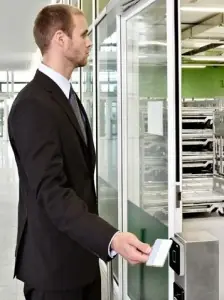 Access control terminal supporting multiple authentication methods.
Access control systems automate who enters and exits restricted areas. Terminals at each access point capture user credentials and validate them against a database — either embedded in the device itself or hosted remotely.
Early systems used PIN keypads. Card readers followed — first chip-based, then contactless — making the process faster and more convenient. Today's terminals combine fingerprint readers, card readers, keypads, and facial recognition cameras in a single unit, with integrated databases suited to smaller deployments.
More complex installations use a bus topology: readers communicate with a central controller that validates credentials and manages access across multiple points. These systems commonly include integrated alarm modules with connectors for motion detectors, shock sensors, and similar peripherals.
Alarm Systems
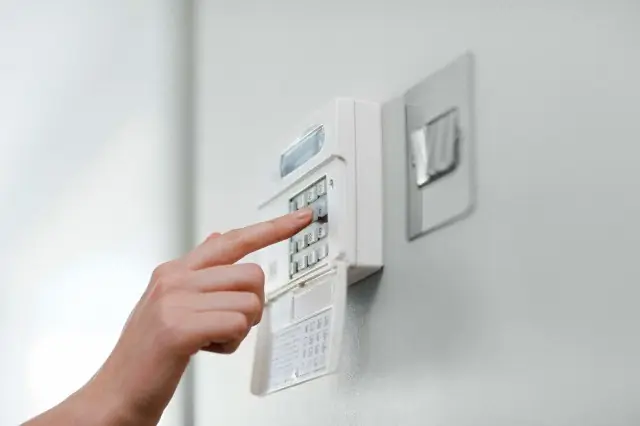 Alarm system with a central panel and distributed sensors.
Alarm systems are designed to detect and signal anomalies in a monitored environment. They are a form of passive security — they alert, but typically don't prevent an incident on their own.
A typical installation includes a wide array of sensors managed by a central controller that aggregates and processes incoming alerts. Modern alarm systems are increasingly integrated with CCTV and access control, enabling coordinated responses across subsystems.
The Future of Electronic Security
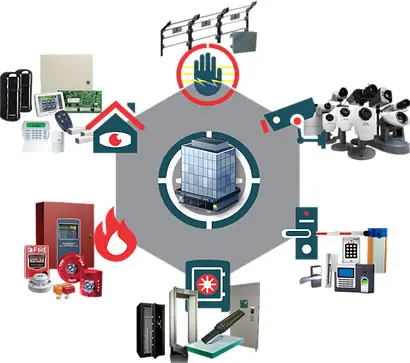 Subsystem convergence points toward intelligent, automated buildings.
Despite significant growth, most electronic security systems have developed in isolation — and that fragmentation makes broader integration difficult. The natural next step is home automation, building automation (inmótica), and urban-scale automation (urbótica): systems capable of responding to any situation automatically and intelligently.
It's not far-fetched to imagine radio communication systems joining this ecosystem in the future. Network-capable radios already exist — a compelling topic, though one for another post.
The shift we need is conceptual: stop treating these systems as isolated islands and start building bridges between them. Once we do, the range of possible architectures and applications becomes virtually limitless.