
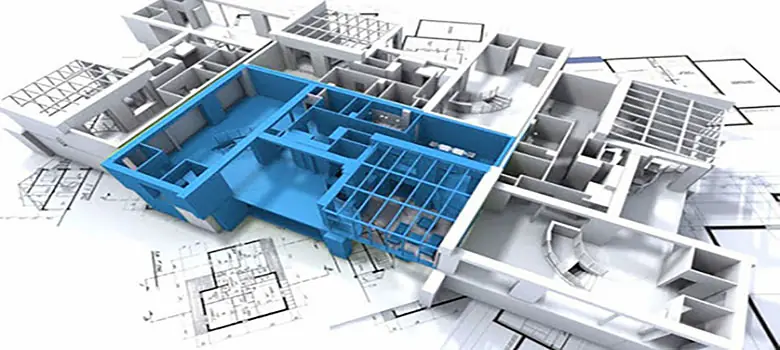
BIM Transformation in Construction
26 February 2020 by Eduardo García Martín
Building Information Modeling (BIM) is one of the most consequential technologies to emerge in construction in recent years. It represents a genuine digitization of design, construction, and how projects interact with their surrounding environment.
BIM has disrupted the industry's traditional production model, repositioning collaborative processes and project information management as the foundational pillars of a new paradigm.
As a methodology, BIM carries significant potential to accelerate digital transformation and raise productivity across the construction sector — and the link between digitization and productivity gains is well established.
The Core of the Shift: Information, Coordination, and Predictability
The real lever here is information, coordination, and process predictability. The convergence of industrialization (Construction 4.0), sustainability, technology, new materials, energy efficiency, and design creates a common ground where manufacturers and distributors can:
- Connect with a new generation of builders, developers, architects, quantity surveyors, interior designers, engineers, and installers.
- Identify upcoming projects — residential developments, hotels, and commercial buildings — before they break ground.
- Present innovations and new products to the right audiences.
- Position themselves as strategic industrial partners within the built environment.
Five Layers of BIM-Driven Transformation
Looking ahead, Virtual Construction and Design (VCD) will enable genuine information control and data analytics at the scale already common in other industries — Big Data applied to construction. This is when a true model shift becomes possible.
Five technology layers are driving this transformation, ranked by expected market adoption rather than importance:
- Internet of Things (IoT) and ubiquitous connectivity
- 3D scanning, embedded sensors, and drones
- Mobile devices, virtual reality, and augmented reality
- Artificial intelligence and smart materials
- 3D printing and construction robotics
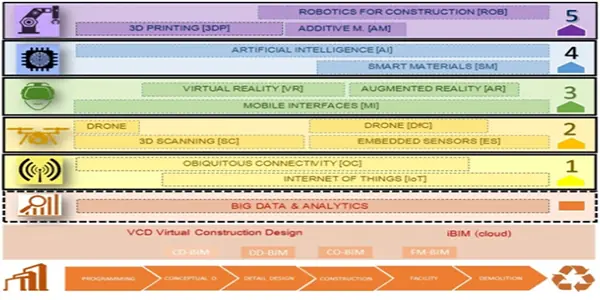 The layered technology stack driving BIM transformation across the construction industry.
Productivity and the Digital Imperative
For a digital transformation to succeed, executives and project leaders must start with a clear definition of how digital tools will create business value — not just a technology roadmap. Equally, they need to invest as much effort in operational change as in the technology itself.
According to McKinsey [1], digital transformation in construction can deliver productivity gains of 14–15% and cost reductions of 4–6%.
Construction firms can improve their odds by identifying the operational changes that will actually move performance first, and then mapping the digital use cases that make those changes possible.
Construction remains one of the least digitized sectors in the global economy, according to the McKinsey Global Institute (MGI) digitization index [1].
The industry is heavily regulated, highly dependent on public-sector demand, and — in many markets — distorted by informality and, at times, corruption. It is also deeply fragmented: contract structures frequently misalign risk and reward, and inexperienced owners and buyers struggle to navigate an opaque marketplace.
The result is chronically poor project management and execution: skills gaps, inadequate design processes, and persistent underinvestment in training, R&D, and innovation.
BIM 5D: Adding Cost and Schedule to the Model
5D BIM is a five-dimensional representation of a project's physical and functional characteristics. Beyond standard 3D spatial design parameters, it incorporates cost and schedule — along with details such as geometry, specifications, aesthetics, and thermal and acoustic properties.
A 5D BIM platform lets owners and contractors identify, analyze, and record the impact of design changes on project cost and timeline before those changes are committed to. The visual and intuitive nature of 5D BIM gives teams a much earlier window into risk, supporting better decisions at every stage. A project planner can, for example, visualize exactly how a proposed design modification will ripple through cost and schedule.
The combination of 5D BIM and augmented reality stands to fundamentally change how construction, maintenance, and operations are managed. To capture the full value, project owners and contractors need to bring BIM in at the design stage — not retrofit it later — and all stakeholders must commit to standardized, BIM-compatible design and data-reporting formats.
That also means allocating real resources for BIM implementation and investing in capability development across the project team.
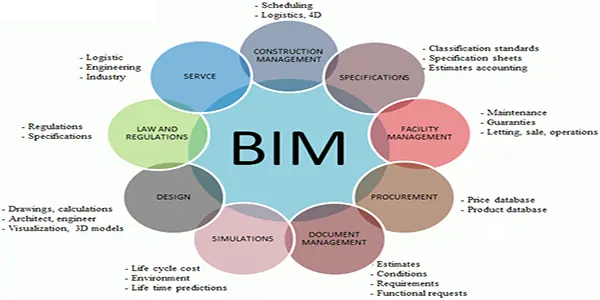 5D BIM and its impact on integrated project management.
From Paper to Real-Time: Digitizing Field Processes
Digitizing construction processes means moving away from paper — toward online, real-time information that enables transparency, collaboration, timely progress tracking, risk assessment, and quality control. The outcome is more reliable project delivery.
Several technology providers have already built tablet and smartphone applications that push drawing and plan changes to site teams in real time, with field photos linked directly to construction drawings. These platforms maintain a master document set with automatic version control and cloud-based access.
Others offer real-time cost coding, worker geolocation, and issue tracking and resolution workflows.
The ability to measure and communicate will become the defining competitive lever in construction. A demonstrable positive impact on cost, schedule, and risk optimization is the most credible case for BIM adoption — and for the broader digital shift the sector needs.
Builders who adapt will lead. Resisting change is no longer a neutral position — it is a deliberate choice with consequences.
Engineer Eduardo Garcia M. egarcia@innotica.net @egm_in2pi
References
- Imagining construction's digital future — McKinsey & Company