

Sustainability and Automation: A Necessity in Times of Crisis
18 February 2020 by Carlos Dobobuto
Most people are well aware that CO₂ emissions — generated primarily by burning fossil fuels to power our cities — are the leading driver of global warming.
In developing countries, it is tempting to treat this as a problem for the world's major economies to solve. The reality is that we live in a globalized world where the actions of any community directly affect a crisis that threatens humanity as a whole.
For the average Venezuelan focused on meeting basic needs, the issue can feel abstract and out of reach. For builders and developers struggling to keep their organizations afloat, projects are designed around minimum possible costs — informed by years of professional experience. Sustainable construction tends to be seen as an interesting concept: something that will inevitably arrive in the future, but currently out of reach because certified methods are assumed to cost more than the approaches that have worked throughout an entire career.
Energy in Venezuela is among the cheapest in the world. To give international readers a frame of reference: the average household pays less than ten cents (USD) per month for electricity. This makes it economically absurd to invest in energy-optimization solutions, since payback periods render them unviable. That is one of the main reasons builders, developers, and infrastructure owners leave energy efficiency out of their operational plans.
This near-zero energy cost — often viewed as a state benefit, but arguably the primary driver of national electrical infrastructure decay — compounds serious deficiencies in water supply services that significantly undermine citizens' quality of life.
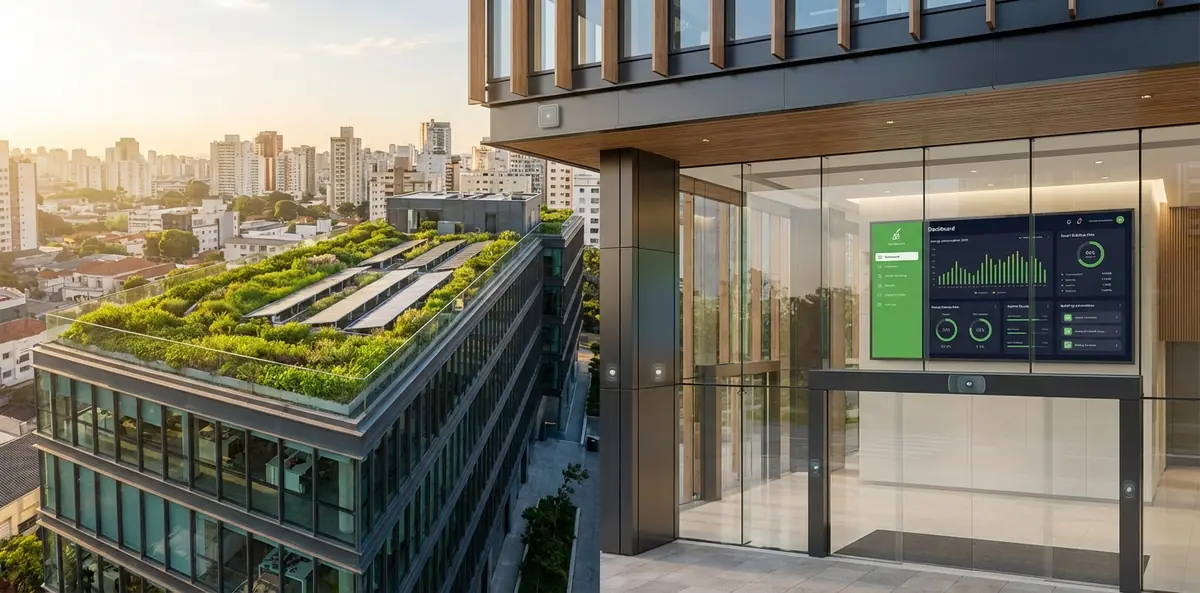 Construction incorporating sustainability criteria in a Latin American context.
The Integrated Sustainability Model
Among the many sustainability certification frameworks available, LEED (Leadership in Energy and Environmental Design), administered by the U.S. Green Building Council (USGBC), is the most widely recognized in the western hemisphere.
LEED is built on a holistic assessment of a facility — covering design, construction, and operations. Projects must meet a set of prerequisites, and the building's performance must match or exceed that of a reference building defined for the same location, shape, and dimensions, provided this does not conflict with local regulations.
This framework pushes every design professional toward maximum efficiency — which translates directly into better capital allocation and lower energy consumption during operations.
Across the region, professional associations and governments have developed policies that incentivize sustainable projects, drawing on national financing alongside purpose-built international funds. These incentives accelerate the growth of an entire industry that generates value for all stakeholders: governments, builders, developers, suppliers, end users, and the environment.
Savings During Construction
A sustainability certification at a given level is ultimately recognition of sound practice during design and construction. One of the most significant aspects is right-sizing the building's subsystems relative to the reference building described above.
This requirement pushes professionals to incorporate the latest design recommendations. Energy simulation tools are essential here: they expose potential over-engineering that can quietly inflate a project's budget.
HVAC is typically one of the most expensive building systems — and also one of the most frequently over-engineered. Applying sustainability principles during the design or construction phase almost always prevents builders and developers from spending budget they simply don't need to spend.
Sustainable construction also encourages the use of recycled materials. One concrete example: recycled rebar can cost up to 30% less than conventional rebar (based on data from a project in Venezuela that followed LEED sustainability recommendations).
 Integrating automation and sustainability in modern infrastructure.
Basic Automation and Sustainability
A sustainable facility does not strictly require automation. That said, even a baseline set of automation capabilities goes a long way toward ensuring that every critical system performs as intended — and that a minimum level of service is maintained.
In the current environment, keeping basic facilities running is genuinely difficult. As conditions tighten, building and maintaining the infrastructure our cities need will only become harder.
Any investment in new infrastructure today must be managed with exceptional care — both in terms of budget and in providing the foundational tools that protect what has been built with considerable effort. At minimum, the following automation and sustainability measures deserve serious consideration:
- Prevent schedule and budget overruns. Design must be given the weight it deserves. BIM methodology — including energy simulations — is the most effective tool for optimizing timelines and costs before a single column is poured.
- Maximize natural water sources. Rainwater harvesting and groundwater systems provide independent supply that does not depend on public utilities.
- Give users visibility into water infrastructure. Tools that let residents, office managers, hospital administrators, or hotel operators monitor supply-line status and tank levels help communities ration this critical resource proactively.
- Eliminate energy waste in lighting and HVAC. Wasted energy is a daily reality — not just in buildings, but across streets, avenues, and public squares. 400 W luminaires running through daylight hours represent a staggering loss of a resource that communities genuinely need.
- Deploy management systems for monitoring, configuration, and reporting. These systems enable both predictive and corrective maintenance. Prioritizing predictive maintenance extends the useful life of infrastructure and reduces total cost of ownership.
- Treat electronic security as a baseline requirement. Security must be assessed holistically — covering both intrusion protection and technical (life-safety) security.
- Build the infrastructure backbone. Lay the cabling, conduit, and network architecture that will support any of the above applications, so that future administrators and users can activate the solutions they need without having to retrofit a building that was never designed for them.
One final point that cannot be overlooked: investing in the professional development of the engineers and project leads who design and build our infrastructure. They are the ones responsible for safeguarding budgets, timelines, and the long-term interests of every project they represent.
Innovating in a crisis is not optional — it is the condition for survival. And while innovation is often associated with additional upfront spending, nothing is more expensive than trying to optimize outcomes while doing everything exactly the same way as before.
Engineer Carlos Dobobuto — cdobobuto@innotica.net — @innotica_ca