
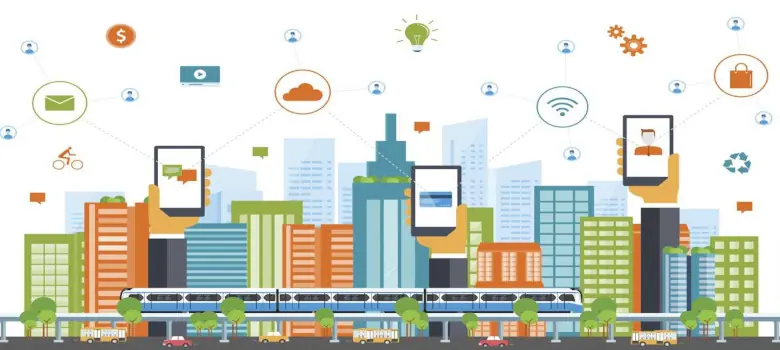
Challenges in Developing City Management Systems
13 April 2021 by Mariel Guanipa
Smart Cities represent a rapidly emerging market for technology companies and entrepreneurs alike. Yet only a small fraction of the world's cities have deployed technologies that meaningfully advance mobility, communication, energy efficiency, or civic engagement.
The core technologies underpinning City Management Systems include:
- Reliable, ubiquitous wireless connectivity. No single solution dominates here. Low-power wide-area network (LPWAN) technologies — LTE Cat M, NB-IoT, LoRa, Bluetooth, and related protocols — are well-suited for urban-scale connectivity. 5G is expected to further strengthen interoperability across smart city infrastructure.
- Cloud computing, an indispensable tool for building city management systems. According to Amazon Web Services, the cloud can provide the storage and analytical capacity needed to process data from urban sensor networks, clearing the path toward more efficient and collaborative cities.
The Real Challenges
Governments — the central actors in urban management — are gradually allocating resources to technologies that improve public-sector processes, organizational efficiency, and quality of life for residents. When it comes to challenges, however, funding sits at the top of the list.
The IoT technologies that power smart cities are not cheap. High-income governments with strong private-sector partnerships are the ones with the financial firepower to invest in urban automation. In Latin America, this is especially difficult: budget priorities are often directed toward other critical needs, with economic survival taking precedence over infrastructure modernization.
 Connected urban infrastructure: one of the foundational pillars of smart cities.
Every device and sensor requires power and network coverage to operate. Cities routinely run into energy costs, maintenance burdens, and internet service limitations that make it difficult to support hundreds or thousands of sensors distributed across the urban fabric.
Without high-capacity internet and reliable connectivity, devices cannot integrate in the way smart cities require — namely, seamless data transfer and aggregation. Internet service providers, both public and private, must upgrade their networks with higher-efficiency infrastructure to make this possible.
Venezuela offers a telling example. A late-2020 article by Arnaldo Espinoza in the digital newspaper El Diario noted that private providers such as Inter and NetUno were leading the shift toward improved connectivity, while the state-owned carrier CANTV was beginning to expand its residential fiber footprint.
Even so, significant barriers remain. Internet access in smaller cities and adjacent rural areas is a persistent problem, since city management systems are rarely accessible or affordable for the entire population. Higher-quality connectivity also comes at a higher cost — and as that cost grows proportionally with improved service, it risks creating new forms of digital stratification.
Energy supply is another major challenge. More systems are needed to guarantee continuous operation of every device, making the integration of renewable energy sources not optional but essential. Solar and wind power should be priorities before a smart city is even designed; coastal cities could then look toward emerging sources such as tidal energy.
Maintenance will always be among the most critical factors for any technology of this scale. Before, during, and after smart city deployment, trained specialists are required to keep systems running at peak performance. Organizations dedicated to ongoing maintenance, continuous staff training, and active research and development will need to emerge — focused on the sustained improvement of systems, devices, and sensors.
 Specialized maintenance is essential to the operational continuity of smart cities.
On the software side — for transportation systems and smart city platforms alike — the core challenge is building applications grounded in simplicity, openness, functionality, visual clarity, and ease of deployment. All the engineering effort behind these technologies ultimately exists to serve residents. For that to work, people need to feel comfortable interacting with their city's systems as part of everyday life.
Physical security is also a genuine obstacle in developing economies, where high poverty rates, homelessness, and property crime leave equipment and infrastructure exposed to theft and vandalism. Public awareness campaigns about the purpose and value of these systems will be a necessary part of any responsible deployment strategy.
Data security presents its own risks. The World Economic Forum ranks cyberattacks as the fifth greatest global threat in its Global Risks Report 2020 — a category that spans data theft, ransomware, and large-scale system compromise. The report specifically flags higher risk for technologies that extend into the physical world, where digital and physical systems are tightly coupled — precisely the environment that defines smart cities.
Smart Cities Are the Future
The goal is clear: improve people's lives in concrete ways — more effective policy execution, less waste, better social and economic outcomes, and greater inclusion for all residents.
Getting there requires a deliberate, well-informed path toward truly intelligent cities — one that accounts honestly for the challenges and the technology gap that still separates ambition from reality.
Mariel Guanipa, Engineer mguanipa@innotica.net · LinkedIn