

Communication Networks for Smart City Projects
31 March 2021 by Christian Urbaez
"The key to a Smart City is deploying a communication network that responds efficiently to a municipality's specific needs."
Communication networks in a Smart City interconnect devices (peripherals) with the people of a society. That interconnection generates the data required to build comprehensive or purpose-specific management systems, calibrated to what each city actually needs.
Edouard Henry-Biabaud, Business Development Manager at Axians, describes the technological foundation of a city as three building blocks: first, communication networks; second, a shared database that stores and correlates all city data transmitted across those networks; and third, specialized applications that support new services for citizens or city management teams.
Those applications become more valuable as they draw on data from multiple sources — giving a closer, more accurate picture of how the city really operates.
Open and Proprietary Standards
The first decision in any smart city project is the communication protocol or philosophy the network will follow. Two broad categories exist: open standards and proprietary (closed) standards.
Proprietary standards are built on vendor-specific technology. Companies design their own communication protocols for their own devices, and those protocols only work between equipment from the same manufacturer — or with third-party equipment through the vendor's own technology stack.
That dependency has real consequences. The project becomes permanently tied to a single brand and manufacturer, which matters most during maintenance and upgrades — the phase where the true long-term cost of a project lives.
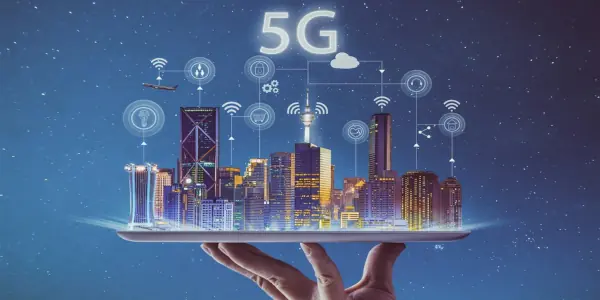 Communication network infrastructure for a Smart City.
Open standards, by contrast, enable interoperability across equipment from different manufacturers. A project can start with a specific set of devices and scale incrementally, integrating additional hardware running different protocols as requirements evolve.
Open standards also give clients real flexibility in vendor selection throughout the entire project lifecycle — from installation and commissioning through to ongoing maintenance. Because no single supplier owns the network, the client always retains the ability to operate it independently and, if needed, replace any vendor without disruption.
Network Connectivity
Connectivity is another critical dimension of any smart city network. The McKinsey Global Institute puts it plainly:
"Before a city can be smart, it has to be networked."
That means the deployed network must deliver the coverage, data-transmission speed, reliability, and efficiency the project demands.
A wired backbone — fiber optic where possible — is needed to link access points, small cells, distributed antenna systems (DAS), surveillance cameras, and other fixed infrastructure. On top of that, a wireless network interconnects the peripheral devices distributed across the municipality: the sensors and endpoints that capture real-world data for storage and management in the city's central platform. [2]
Available Wireless Technologies
A wide range of wireless solutions can meet the needs of a smart city network. The most relevant today include:
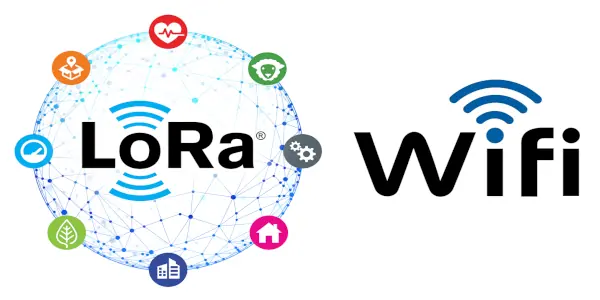 Comparison of wireless technologies used in smart city projects.
LoRa: Designed for fully distributed, low-power wide-area networks (LPWAN), LoRa is well-suited to sensor networks deployed across a city — contexts where powering devices can be genuinely challenging. The protocol transmits small data packets over long distances: in line-of-sight conditions, a link can theoretically reach up to 12 km. Beyond point-to-point links, LoRa also supports mesh topologies, enabling multiple devices to extend coverage distances cooperatively. [4]
Wi-Fi: Wi-Fi allows devices to communicate with each other or access the internet through a wireless access point. Its range of standards covers a broad ecosystem of devices, and deployment costs are relatively low compared to licensed-spectrum alternatives.
5G: The fifth generation of wireless communication standards, 5G is the network that mobile and connected devices use to access the internet from virtually anywhere. Data speeds are up to 100× faster than 4G, with a more robust and stable connection architecture that reduces latency to 1–10 ms.
Which Technology Is Best?
Given all these options, which wireless technology is the right choice for a smart city communication network?
The honest answer: all of them. Each technology addresses a specific set of requirements around coverage, reliability, and efficiency. Because a municipality has diverse and overlapping needs, the most effective approach is typically a combination — with all data flows converging in a unified city management platform from which the full operation can be monitored and controlled.
References
- No existirán ciudades inteligentes sin redes eficientes — Redes Telecom
- Redes de fibra óptica: los cimientos de una ciudad inteligente — Energía Hoy
- ¿Cuál debe ser la infraestructura de comunicación para la ciudad inteligente? — The Agility Effect
- Glosario ciudades inteligentes Smart Cities — Sittycia
Christian Urbaez — curbaez@innotica.net — LinkedIn