

Communication Protocols for Building Management Systems
7 October 2020 by Christian Urbaez
Most buildings operate with isolated subsystems — a setup that drives up energy consumption and inflates both operational and maintenance costs.
That's precisely why more buildings are adopting a Building Management System (BMS). Beyond delivering energy savings of up to 70%, a BMS reduces the labor required to install, configure, and commission new equipment, improving the overall return on investment for building owners.
One of the defining characteristics of a BMS is that it is an open system: it unifies the management of every building subsystem — lighting, HVAC, electrical metering, CCTV, access control, and more — within a single platform.
How does that work in practice? Through interoperability. Regardless of manufacturer, every device in each subsystem must be able to communicate with the others. This has long been the industry's central challenge, and it has been progressively solved through the adoption of open communication protocols.
Open protocols are those in which all design elements within a system can work with compatible components from different manufacturers. Their core advantage is flexibility: a system can be built from best-fit equipment across vendors, provided those devices guarantee compatibility and proper operation. The most widely used protocols within a BMS are the following:
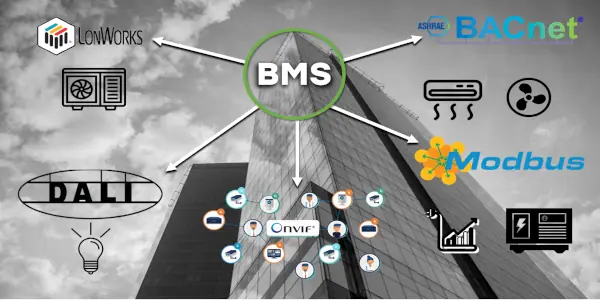 The main communication protocols used in BMS environments.
BACnet
BACnet is an open, non-proprietary communication protocol — and the most comprehensive and capable standard for Building Automation and Control Networks.
It was designed to interconnect applications such as HVAC systems, lighting control, access control, and fire detection systems. BACnet currently supports seven distinct network types; the two most widely deployed are BACnet MS/TP and BACnet IP, favored for their lower cost and broad market penetration.
Modbus
Modbus is another open communication protocol, used to transmit information over serial networks between electronic devices. It has become the de facto standard wherever industrial automation systems (IAS) or building management systems require integration, largely because it is straightforward to implement and highly reliable.
Modbus operates on a master-slave architecture and uses serial transmission (RTU and ASCII), typically over RS-485 and TCP/IP networks. Its applications include:
- Remote monitoring and control systems.
- Industrial automation and Smart Grids.
- Control systems and enterprise networks.
- IoT integration (via gateways that bridge Modbus to IP-based networks).
- Building management systems (HVAC, wastewater, water supply).
- The oil and gas industry.
 Modbus application diagram across industrial and building environments.
Dali
DALI (Digital Addressable Lighting Interface) is a protocol developed specifically to control lighting systems equipped with compatible ballasts. It supports two-way communication, allowing luminaires to report status back to the controller — for example, flagging a lamp or ballast fault.
To achieve dimming control, DALI requires a control bus that maintains bidirectional communication between the master controller and each individual luminaire. A single DALI network supports up to 64 luminaires, which can be organized into as many as 16 groups. Primary application areas include:
- Ambient lighting environments (clinics, airports, department stores).
- Theatrical and display lighting (exhibition halls, retail spaces, concert venues).
- Functional lighting control (office buildings).
LonWorks
LonWorks is a technology platform built on the open LonTalk protocol, designed for control and automation applications. It distributes intelligence in a decentralized way — pushing it out to small nodes or devices within a larger system, where those devices exchange information to carry out functions such as measurement, data processing, switching, and regulation across facilities and infrastructure.
Key LonWorks application areas include:
- Building automation: residential, office, retail, and hospitality environments, where all building subsystems are managed — HVAC, lighting, security, access control, fire detection, and energy.
- Public lighting: remote infrastructure management and energy control through luminaire switching, dimming, occupancy detection, and daylight sensing.
- Transportation: monitoring and control of railway infrastructure and rolling stock, covering lighting, propulsion, braking, and door systems.
- Industry: supervision of industrial processes, wastewater treatment, lighting, ventilation, and related systems.
Onvif
ONVIF (Open Network Video Interface Forum) is an open industry standard that provides interoperability between IP security devices — including security cameras, video recorders, management software, and access control systems [1].
When IP security devices share this protocol, they can receive a common command set and execute instructions uniformly. ONVIF reduces integration complexity and eliminates the need for custom driver development, saving time and cost during project deployment.
As specialists in building control and management systems, it is essential to require every designer or equipment supplier to specify devices based on the communication protocol selected for the BMS network.
When a device does not natively support that protocol, it must be integrable through a communication gateway that translates data from the proprietary protocol into the management system's protocol. Only then can the client be assured of correct integration and genuine interoperability across all equipment and subsystems.
Engineer Christian Urbáez — Project Engineer — curbaez@innotica.net — LinkedIn