
Instrumentation and Control for Building Management
30 September 2020 by Lisgrett Bellorin
Instrumentation and control originated in industrial settings, born from the need to optimize human resources, raw materials, and production processes. The discipline has since moved into residential and commercial buildings, where the drive for continuous improvement demands that automation in these infrastructures keeps evolving — delivering tangible benefits to end users:
- Energy savings across systems and consumption.
- Improved personal and asset security.
- Greater comfort and quality of life.
- Remote facility management.
Automation is only possible when you have elements that can measure, convert, and record the variables at play in a managed environment — then transmit and evaluate those readings so a pre-programmed action can be taken on the system. The set of tools that makes all of this happen is what we call instrumentation.
From Concept to Commissioning
When the idea of automating a facility takes shape, the project comes to life through its conceptualization phase. Design criteria are established to determine the placement of sensors, controllers, communication gateways, and actuators — each one selected to execute the control strategies defined by the automation engineer, aligned with the requirements of the building's different subsystems.
The instrumentation needed to implement those strategies depends entirely on their complexity. The spectrum runs from a simple occupancy detection system in a private office all the way to automatic control of an underground parking ventilation system based on real-time CO₂ readings.
Each subsystem's specific requirements drive the instrumentation selection: choosing the most appropriate sensors and detectors for the type of variable to be measured and transmitted — whether via an analog or digital signal.
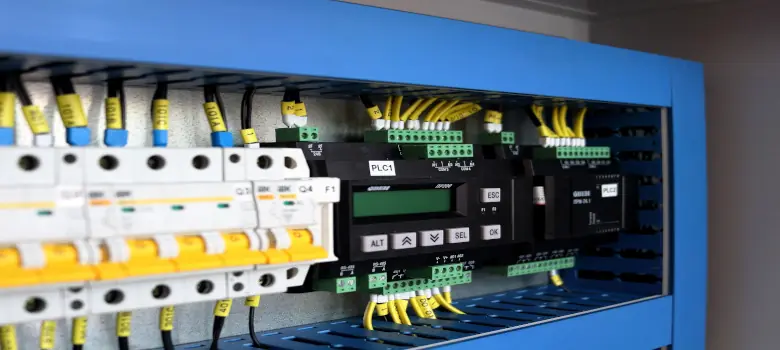
 Sensors and controllers installed as part of a building automation system.
The same logic applies to actuator selection: each one is chosen based on its role within the system. Controllers are the devices responsible for receiving signals from sensors and issuing the corresponding commands to actuators — commands they execute according to the operational logic programmed into them.
Control strategy definitions for each subsystem are guided by the client's or end user's needs, always referencing the base design developed by the relevant subsystem specialist, which the automation strategies then complement.
The Coordination Imperative
Automation and control within any infrastructure requires constant coordination with nearly every other discipline involved in the project. This means the technical team responsible for this area needs a working knowledge of almost all of them — knowledge that comes from a solid educational foundation or, more often, from years of hands-on experience.
The discipline demands that its practitioners engage with every other engineering specialty on the project. That means coordinating with civil works engineers on the location of control rooms, equipment placement, and cable conduit routing — and working alongside electrical engineers to define power supply criteria for instruments, controllers, and actuators, as well as cabling standards, grounding, and related requirements.
 Cross-discipline coordination is critical to the successful implementation of control systems.
The team developing an automation and control project cannot work in isolation. They must move in lockstep with every other specialist on the project — that's the only way to achieve the defined strategies and deliver on the implementation objectives the project was created to meet.
More Than a Complement
Automation and control is more than an add-on to the traditional disciplines that make up a building. It is the gateway through which technology enters infrastructures that could, technically, be built the conventional way — but would fall further and further behind in a world where the pressure to optimize natural resource use, minimize environmental impact, promote energy savings, and maintain indoor air quality grows stronger every day.
Lisgrett Bellorin Project Engineer lbellorin@innotica.net · LinkedIn