

COVID-19 Prevention on Construction Sites
10 June 2020 by Maria Teresa Rodriguez
More than two months into a mandatory national lockdown triggered by COVID-19, the economic toll of halting entire productive sectors has become undeniable.
Many countries that have moved past the acute phase of the crisis are already entering phased reopening, with the goal of restoring economic, commercial, and financial activity. The question every site manager should be asking is: are we ready to go back without putting our teams at risk?
This post focuses on the construction sector, where a formal return-to-work protocol must be in place before civil works resume.
These guidelines apply to everyone involved in the construction process — permanent site staff and any visitor or contractor entering the work area, without exception.
As occupational safety coordinators, the first thing we need to understand is exactly what we are dealing with: what this virus is, and what risk profile it creates on a construction site. COVID-19 is not classified as an occupational disease, but that does not reduce our obligation to manage it with the best available information. It is a public health problem that reaches beyond the personal and the professional — which makes it a matter of both individual and collective responsibility.
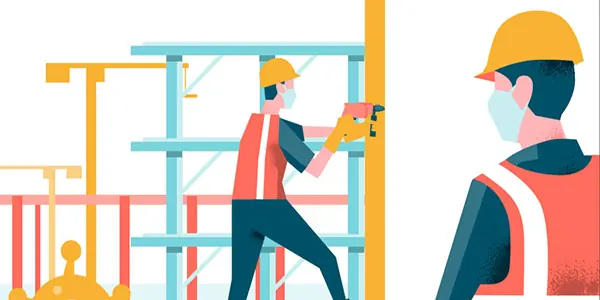 COVID-19 prevention measures applied on a construction site.
Prevention Measures for Construction Site Protocols
The following measures should be treated as mandatory in any start-up or restart protocol for construction operations.
-
Screen every person entering the site and log the results. This means measuring body temperature and blood oxygen saturation (pulse oximetry). Anyone presenting readings consistent with COVID-19 clinical signs must be separated from the workforce immediately and referred to the procedures established by the relevant health authority.
-
Require a health declaration form from every worker who joins or returns to the site. This symptom checklist should be self-reported, mandatory, and filed on record.
-
Post information panels at multiple points throughout the site with the basic guidelines for preventing contagion. Workers must be briefed on the content of the plan, and the plan itself must be annexed to the Occupational Health and Safety Plan.
-
Communicate the basic prevention guidelines — both verbally and in writing — to all personnel. This should be delivered as part of mandatory occupational health and safety training.
-
Plan work activities so that a minimum physical distance of 1.0 metre is maintained at all times — at entry, exit, and throughout the workday. Where possible, stagger arrival and departure times to avoid bottlenecks at access points.
-
Supply workers with the hygiene products they need to follow individual health recommendations, adapted to each specific task.
-
Identify activities that tend to create crowding and restructure them. Staggered shifts and individualized work assignments are effective tools for eliminating unnecessary gatherings within site facilities.
-
Conduct a mandatory occupational medical assessment to identify age groups and individual risk levels before any site activity begins.
-
Include temperature checks at both entry and exit as a routine control measure, and define clear procedures for what happens if a worker shows symptoms while on site.
-
Establish a regular disinfection schedule for all site areas, with particular attention to restrooms, changing rooms, and dining facilities.
-
Apply the same disinfection schedule to equipment, machinery, and tools.
-
Keep worker contact information current so that anyone in a given area can be traced quickly if a COVID-19 case is confirmed in that zone. Follow the protocols and recommendations issued by the Ministry of Health.
-
Arrange dedicated transportation for workers to and from the site, avoiding exposure on public transit. Vehicles must operate at no more than 50% seating capacity to maintain safe distancing, and should be disinfected on a regular schedule.
-
For camp-based projects or sites that require workers to stay on-site, opt for the longest shift rotation permitted by law in order to reduce the frequency of exposure. Accommodation and common areas must also comply with distancing and occupancy requirements under current regulations.
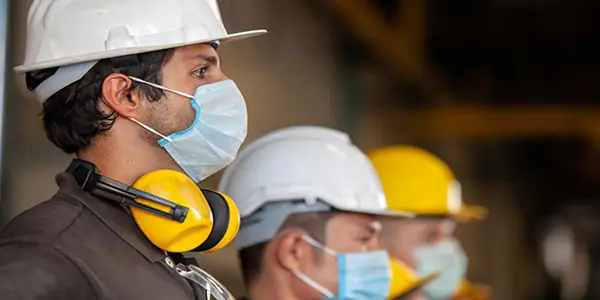 Biosafety protocol applied on a civil construction site during the pandemic.
A Turning Point for Construction Safety
This pandemic has exposed a hard truth: the construction sector was not prepared for this kind of challenge. And because crises like this can recur, a complete halt to construction activity is not a viable long-term response.
The time has come to develop new safety, hygiene, and occupational health plans — ones built with a broader vision than the protocols that have governed the industry until now.
María Rodríguez Project Supervision and Control mrodriguez@innotica.net