
Industrial Internet of Things
23 August 2016 by Johautt Hernández
The Internet of Things (IoT), as engineer Eduardo García described in an earlier post, connects everyday objects to the internet — creating new ways to collect and exchange information. That integration improves efficiency, safety, and comfort across virtually any system it touches.
The Industrial Internet of Things (IIoT) applies the same core concept to manufacturing and industrial operations. The name says it all: it's IoT, scoped to the industrial sector.
IIoT encompasses smart devices that participate in part or all of a production chain. They change and improve how industrial processes behave, optimize resource management, collaborate with each other and with the people working alongside them, and deliver real-time status reports to managers, clients, and suppliers alike. The result is better maintenance quality and stronger workplace safety conditions.
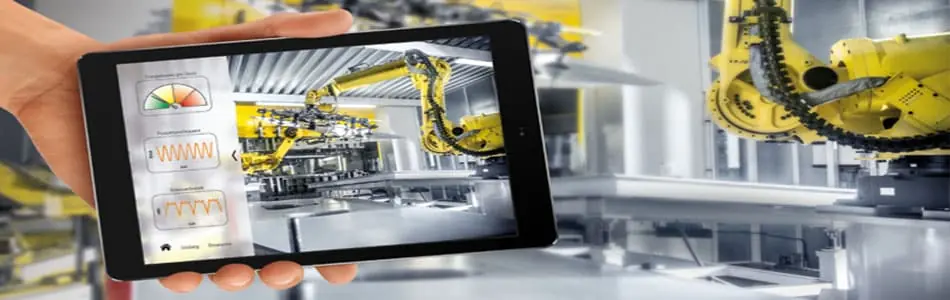
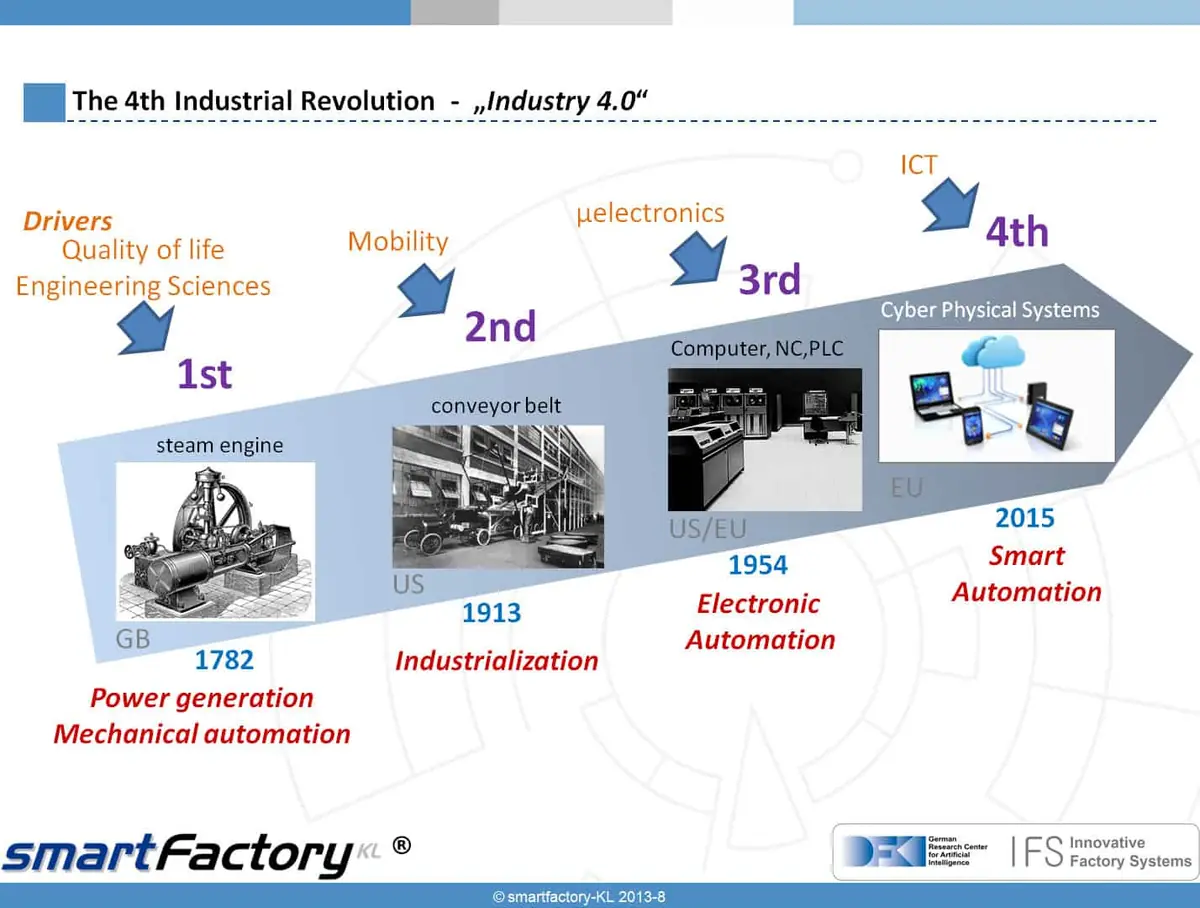
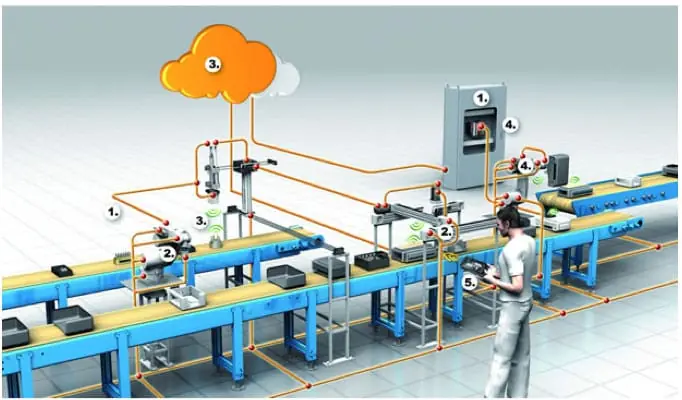
This is where Industry 4.0 — the fourth industrial revolution — enters the picture. Through IIoT, we move into the era of smart factories: facilities where sensors, actuators, controllers, and applications (components of robotic and automated systems) interconnect locally and push useful data out over the internet.
The trend looks irreversible, just as the advance of IoT and Big Data is irreversible. Big Data, in particular, is highly relevant within IIoT contexts — especially when production volumes and company scale are large enough to generate enormous quantities of data.
Like every significant technological shift, IIoT creates new opportunities and new challenges. Both need to be understood before the full potential of any integrated system can be realized.
 Smart devices connected across an industrial plant floor.
Opportunities
The opportunities IIoT presents are wide-ranging, and they all point toward the same outcome: higher industrial productivity. Collecting far more process data — faster, more efficiently, and at significantly lower cost — becomes possible. Pair that data with applications that store, manage, analyze, and act on it, and industrial operations can make better decisions, or have decisions made for them automatically.
Predictive maintenance. Consider a vibration sensor mounted on a high-value industrial electric motor. Drawing on its own data, the sensor can predict a failure condition, estimate the motor's remaining service life, and identify which component is likely to fail first. That sensor connects remotely to the maintenance supervisor — via phone, tablet, or laptop — who then schedules a planned shutdown for predictive maintenance with the team.
A cloud-hosted expert-system application can guide the team through the repair faster. A robotic system controlled from a tablet can assist where precision is critical or conditions are too hazardous for personnel. The outcome: avoided downtime costs, no cascading damage to other equipment, no forced full replacement — and a clear picture of how degraded performance was already affecting product quality and throughput.
Worker safety and coordination. Equip each worker with one or more networked smart devices — or even augmented-reality headsets — as part of their standard kit. In noisy environments or across long distances on the plant floor, coordination becomes far simpler. Workers can access live data on inventory, raw materials, available stock, and production targets relevant to their role, helping them optimize their own output.
Should a worker enter a dangerous situation or suffer an accident, those devices coordinate with the surrounding system: stopping the process causing the hazard, reversing the dangerous condition, alerting colleagues, and calling emergency services if needed.
Inventory and supply chain visibility. A network of strategically placed field devices can track inventory, raw materials, sub-products, finished goods, and production targets in real time. Product quality can be assessed and improved continuously. Managers can monitor all of this from anywhere, at any time — knowing how soon production targets can be met, whether a new client order is feasible by a specific date, and much more. When the data volume grows beyond what any one person can process efficiently, server-side applications distill it into exactly what each stakeholder needs.
Suppliers gain real-time visibility into material consumption rates, allowing them to plan deliveries with greater precision. Clients can track the status and quality of their orders in real time, estimate delivery dates, and receive early alerts if any condition threatens product integrity.
Freight monitoring. Smart sensors installed on cargo vehicles and connected to the network can monitor shipment condition in real time — flagging environmental changes that could compromise product quality, reporting vehicle location, warning of potential mechanical failures, flagging route delays, and helping optimize fuel consumption. The combined effect is better product quality assurance and more accurate delivery estimates, alongside measurable cost reductions.
 Real-time freight monitoring via networked sensors.
Challenges
IIoT is steadily gaining ground and will substantially reshape industrial operations. But the risks are real and must be addressed — leaving them unmanaged can lead to serious or even catastrophic consequences. Every new technology involves trade-offs, and IIoT is no exception.
Vulnerability to cyberattacks. Any device controllable over a network is potentially vulnerable to attack. Unauthorized access to a networked sensor, controller, or actuator allows an attacker to manipulate its parameters or control loop variables — risking process damage, destruction of expensive machinery, or industrial accidents. The problem is compounded by legacy control systems never designed for this kind of network exposure, and therefore not hardened against malicious intrusion.
Wireless communication adds another layer of risk. An attacker can disrupt a wireless device's operation without gaining direct access to it — through electromagnetic jamming, the deliberate interference technique used in military contexts to degrade an adversary's communications by collapsing the signal-to-noise ratio at network nodes.
Confidential data protection. Beyond operational sabotage, cyberattacks targeting IIoT infrastructure can result in the theft of sensitive business information: internal design documentation, proprietary chemical formulations and their precise ratios, legal and financial records, and other trade secrets.
Reliability in industrial environments. IIoT devices face far harsher demands than typical consumer IoT hardware. Industrial processes often require deterministic, consistently low-latency communication to maintain real-time control stability — regardless of network load or connection complexity. Devices must operate reliably in conditions of elevated temperature, humidity, vibration, electrical supply noise, and electromagnetic interference that are common on plant floors but would destroy consumer-grade hardware.
Communication links must guarantee latency and determinism under load. Device enclosures must condition internal circuitry against the operating environment. Internal components must meet industrial-grade temperature ratings. Communication interfaces must function correctly despite high ambient noise. Meeting all of these requirements simultaneously makes IIoT hardware design a genuinely complex engineering discipline.
 Network architecture in an IIoT-connected industrial plant.
Real-World Applications
The opportunities are significant — and many companies are already capturing them to improve efficiency, industrial safety, financial performance, and new revenue streams. A few examples:
- Michelin uses in-tire sensors combined with analytics to coach fleet truck drivers on fuel-saving techniques.
- Taleris (a General Electric–Accenture joint venture) deploys analytics to help airlines minimize disruptions from mechanical failures and weather-related delays.
- Daimler, through its Car2Go service, moved beyond vehicle manufacturing into vehicle rental — making the process nearly as frictionless as buying groceries.
- GT Nexus (a cloud platform provider) partnered with supply-chain analytics firm TransVoyant to combine GPS data with cargo information on ships and trucks, giving clients precise, real-time shipment location and status.
- Rio Tinto operates autonomous haul trucks at its Pilbara mining sites remotely from its operations center in Perth, Australia — roughly 900 miles away.
- Joy Global (a Rio Tinto competitor and mining equipment manufacturer) uses sensor technology in a remote-controlled extraction device that can be deployed into dangerous mine shafts in place of human workers.
- General Electric, both a user and provider of IoT tools, is at the leading edge of this technology — alongside Bosch, Cisco Systems, Intel, and Siemens, all of which are entering the IoT business while simultaneously using the technology to improve their own production processes.
- Rockwell Automation (Milwaukee) had completed approximately 80% of its planned IoT upgrade across its global plants, according to John Nesi, Vice President of Market Development and head of the Connected Enterprise initiative.
Hardware Design: Notable Approaches
Designing devices for IIoT is considerably harder than designing for consumer IoT — but several manufacturers have already committed to the challenge with their own platforms. These are just a few representative examples; the broader ecosystem is growing rapidly.
- Linear Technology offers the SmartMesh product family, with two lines — SmartMesh WirelessHart and SmartMesh IP — targeting IIoT wireless communication. The company claims network reliability exceeding 99.999%, very low power consumption, industrial-grade cybersecurity, and a mesh communication architecture that routes data through intermediate nodes to extend range and reliability. Some SmartMesh ICs include an ARM Cortex-M3 processor to simplify hardware development and integration.
- Echelon, with its IzoT platform, offers a broad range of connectivity options: management and commissioning software, routers, network interfaces, chips, modules, and development tools — all based on the LonTalk/IP protocol. The IzoT SDK 2 allows developers to build IIoT communication devices using well-known open-hardware platforms such as Raspberry Pi and BeagleBone Black.
- Industrial Shields is a Barcelona-based Spanish company that has developed low-cost PLCs built on the popular Arduino development board. Their products comply with applicable industrial safety standards and follow established industrial design, quality, and safety parameters. All products are registered under a Creative Commons license. The current lineup includes Arduino-based PLCs, touchscreens with integrated Linux, industrial sensors, automation modules, mechatronic systems, and equipment.
A Technology Worth Watching: Li-Fi
An emerging wireless communication technology may soon allow industrial devices to exchange data in a fundamentally different way — and at speeds well beyond what current approaches can offer. That technology is Li-Fi.
Frank Deicke, who leads Li-Fi development at the Fraunhofer Institute for Photonic Microsystems, described a system his team was developing — most likely using infrared light and aimed at industrial users rather than consumers. He noted that the data rates achievable with their system would be a genuine challenge to replicate with Wi-Fi or Bluetooth.
He also highlighted a second advantage that matters enormously in industrial applications: latency. Wi-Fi latency — the delay between when a signal is sent and when it is received — is typically measured in milliseconds. Li-Fi latency is measured in microseconds.
In industrial environments where data must flow continuously between sensors, actuators, and a control unit, those low latencies and high data rates would make Li-Fi viable precisely where Wi-Fi falls short.
There is an additional security benefit: because light cannot penetrate certain materials, Li-Fi communication is inherently more contained — an advantage in the physically enclosed environments typical of industrial facilities.