
Industry Associations and Smart Buildings: Digital Transformation as a Starting Point
9 December 2020 by Eduardo García Martín
In the construction sector, industry associations represent the interests of the entire value chain — companies and professionals alike — and hold real influence over decisions that shape the sector's development and growth.
We are entering a different economy. Knowledge is becoming the center of gravity, and ethics — and with it, the trustworthiness of professionals, firms, and the associations that represent them — will be what sets the best apart from the rest.
Reviving the construction sector requires integrating every stakeholder around a single objective: the development of the industry and the country. That means leaving failed models behind and allowing the state to fulfill its genuine role as a facilitator of investment. There is no room for the past.
On that note, I want to cite two statements from the 76th Annual Convention of the Venezuelan Chamber of Construction (CVC):
"We want to emphasize the tools that companies and the nation need to carry out the reconstruction of the country and build the infrastructure that society requires to have the services and quality of life that Venezuelans deserve." — Mauricio Brin Laverde, President, CVC
"Challenges of Venezuelan Construction, Public-Private Partnerships (PPPs), Innovation, and Sustainability." Under this theme, the Venezuelan Chamber of Construction (CVC) held its 2019 Annual Construction Convention on October 29. During the event, members celebrated the institution's 76th anniversary. — Press release, October 25, 2019. El Estímulo editorial staff
Those messages from the convention centered on three themes:
- Public-Private Partnerships (PPPs) as a development model to promote meaningful private-sector participation in infrastructure.
- Innovation and construction under sustainability criteria.
- BIM (Building Information Modeling) as a methodology used worldwide to ensure the successful conception, development, and completion of both building and infrastructure projects — with the launch of the BIM Venezuela Chapter as a milestone of the event.
In Venezuela, the construction sector's associations are beginning to take these initiatives seriously. Even so, the real push will only come when those who design, develop, and build shift from saying "we should be responsible for" change to saying "we are responsible for" it.
That distinction matters. "We should be" is a weak commitment — it leaves the door open for the role to never actually be assumed. "We are responsible" means the role has been taken on, leadership has been claimed. That is the real challenge.
Is Technology Part of the Sector's Strategic Plan?
Those of us who participate actively in construction industry associations have watched as technology and innovation are gradually incorporated as strategic pillars within sector planning. The support was tentative in the past — today, the interest is visibly stronger.
We are witnessing the emergence or resurgence of associations such as the CVCS (Venezuelan Council for Sustainable Construction), alongside the growth of a broader tech ecosystem: PropTech — PropTech Latam / Venezuela — followed by ConTech and FinTech, representing startups tied to innovation and blockchain applied to real estate finance [4].
The current moment presents a unique opportunity to accelerate the adoption of greater connectivity and automation across design and construction processes. More than that, these advances can serve as a platform for meaningful steps toward the smart, sustainable city — a destination the world is already moving toward.
Associations are being shaped by member companies that are pulling their peers into these movements. Workshops, forums, webinars, and management-focused courses are proliferating, promoting the training and upskilling needed for both current and future decisions.
The CVC is actively driving the BIM Forum Venezuela, and the Venezuelan Society of Engineers (CIV) — another long-standing professional body — is spreading adoption of the methodology alongside numerous independent professionals and firms who have become its strongest advocates.
Meanwhile, the Real Estate Chamber achieved the launch of the CVCS — Venezuelan Council for Sustainable Construction. What will differentiate this region is whether both trends — BIM adoption and sustainable construction — become institutionalized and integrated into a coherent value proposition that drives genuine digital transformation, ultimately producing certified processes that add measurable value.
 The drive toward more efficient and sustainable projects is accelerating the adoption of new technologies, including building automation and bioclimatic design strategies.
The global push for more efficient and sustainable projects is not something the construction sector can ignore. Architectural projects face growing demands, requiring the combination of new technologies — building automation systems applied alongside bioclimatic strategies — to ensure sustainability, control costs, and ultimately reduce environmental impact.
Sustainability in Construction: A First Step Toward a National Strategy
The production costs of sustainable building decrease as owners and their design and construction teams gain experience, develop skills, and learn the most cost-effective ways to hit specific targets.
Construction has historically been one of the lowest-productivity industries globally — a consequence of near-zero innovation, despite having the tools to do otherwise. Innovation is a prerequisite for digital transformation.
The situation is compounded by regulations that do not support project success, obsolete contract structures, and poor understanding — on the part of both public and private clients — of what is actually being commissioned. Long-standing procurement inefficiencies persist, and the industry's own actors have shown little boldness in changing them.
Given all of this, a useful lens is the VUCA framework. Organizations today operate in an environment defined by:
- Volatility
- Uncertainty
- Complexity
- Ambiguity
The VUCA concept originated in the 1990s within the U.S. military to describe the post-Cold War world, and has since migrated into business strategy [1]. In a VUCA environment, staying competitive requires moving at least as fast as the sector itself — and digitalization is the genuine lever for that shift.
A corresponding framework — VUCA Prime — offers a practical response [1]:
- Counter volatility with Vision: a clear, well-grounded picture of where the organization is headed.
- Counter uncertainty with Understanding: continuous learning, training, and informed decision-making.
- Counter complexity with Clarity: simplicity and directness in how tasks are structured and executed.
- Counter ambiguity with Agility: the capacity to respond quickly when the unexpected threatens the strategic plan.
Companies tied to innovation are already leading with this mindset — building collective knowledge, running lean and effective operations, and breaking through the inertia that holds industry associations back.
The question that follows is: how can institutional innovation keep pace with technological advancement and allow entire sectors to progress in an era of inevitable surprise and growing complexity?
My answer: we have mental models and structural habits that worked well enough until now — but we have to be willing to question them if we want to remain relevant. A VUCA environment generates new questions, and those questions demand different kinds of answers. The challenge inside most organizations is exactly this: leaders and people in general tend to reach for the same familiar responses.
Leadership through this shift must happen at every segment of the value chain — including end users, the occupants of buildings, who are ultimately the segment driving demand for new solutions: better materials, greater comfort, efficiency, security, and connectivity. Those are precisely the characteristics that define the smart, sustainable buildings of the future.
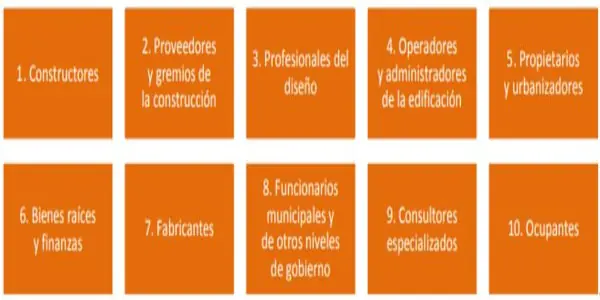 Leadership in digital transformation must reach every segment of the construction sector's value chain.
Beyond the cultural shift, several technological innovation areas should be treated as strategic priorities for any construction business:
- Cloud Integration: leveraging the capacity and flexibility of the cloud should no longer be optional. It enables the analysis and storage of large volumes of information securely and at scale.
- Flexibility and Adaptability to Technological Innovation: the challenge is not simply deploying a BIM solution. It is changing the organization's mindset toward innovation altogether. Rapid adoption of IoT, additive manufacturing, and augmented reality will be what separates leaders from laggards.
- New Efficiency-Oriented Management Models: using the operational efficiencies available in construction to drive a gradual transformation toward a higher-value, higher-innovation industry — redefining business variables around efficiency [3].
- The SMAC Stack: what began as software market trends have become core to competitive business DNA. To compete today, both information systems and organizations must be more Social, more Mobile, more Analytics-driven, and more Cloud-native.
- Business Analytics: processing large datasets analytically can enable construction companies to make the right decisions in real time. With Business Intelligence systems, every record becomes a potential data point. The challenge — and the opportunity — is transforming that data into insight, and insight into prediction, and prediction into decisions [2].
Anyone who has worked on developing a strategic plan for a collective body knows that looking out over a long time horizon is genuinely difficult in a VUCA environment.
For now, I leave the sector with three open questions: Is there real awareness of the change underway? How is the industry responding to the speed at which it is evolving? Does long-term thinking actually appear in strategic plans? The answers will largely determine whether construction associations remain relevant in the years ahead.
The time has come to stop being overwhelmed by change — and to start leading it.
References
- VUCA: Change as the New Normal
- 6 Challenges and Opportunities of Digital Transformation in Construction Within a VUCA Environment
- U.S. Allocates $335 Million to R&D for New Construction Technologies
- FinTech, PropTech, FemTech, EdTech and Their Relatives
- Venezuelan Chamber of Construction Organizes the 2019 Annual Construction Convention
- Using BIM to Achieve Net-Zero Energy Consumption
- Improving Conditions for Green Building Construction in North America
Engineer Eduardo García Martín — egarcia@innotica.net — LinkedIn