
LPWAN and LoRa Networks for Smart Cities
29 April 2021 by Johautt Hernández
As consumer electronics become cheaper, smaller, and more capable — and internet access continues to expand — a clear trend has emerged: connecting devices of all kinds to the internet to serve a purpose defined by their design, making everyday life easier in the process.
Personal computers, laptops, and servers were just the beginning. Today, mobile phones, home appliances, smart TVs, and gaming consoles are all part of the connected fabric.
Beyond individual devices, we're seeing the rise of networked sensor arrays: systems designed to feed data to each other and to back-end databases, where software makes sense of it all — measuring regional climate conditions, understanding what drives energy consumption in a building, and much more.
One persistent challenge is connectivity. Running cable to remote devices is expensive. Assigning mobile data plans to hundreds of low-power sensors is costly and often impractical. And most wireless technologies carry a steep battery penalty — a critical drawback when a device needs to run autonomously for months or years.
That's where LoRa comes in. LoRa is a communications technology that allows two or more IoT devices to exchange data over long distances at low power and low cost. It makes possible a new class of small, battery-efficient devices that can communicate across kilometers without a cellular contract or a wired connection.
When internet connectivity is needed, a gateway device — installed where power and internet access are available — bridges those field nodes to the rest of the world. This enables remote monitoring, data collection, and the processing pipelines that ultimately deliver actionable information to end users.
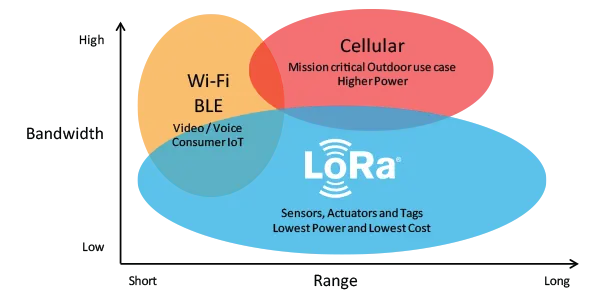 Example LoRa network architecture for long-range, low-power IoT devices.
A few key terms help frame the technology:
IoT (Internet of Things): the network of physical objects embedded with sensors, software, and other technologies that connect and exchange data with other devices and systems over the internet [4].
LoRa (Long Range): a chirp spread spectrum modulation technique developed by Semtech. LoRa devices and Semtech's wireless RF technology together form a long-range, low-power wireless platform that has become the de facto standard for IoT networks worldwide [1][2].
CSS (Chirp Spread Spectrum): a spread-spectrum technique used in digital communications that encodes information using wideband linear frequency-modulated chirp pulses. A chirp is a sinusoidal signal whose frequency increases or decreases over time — sometimes exponentially [3].
LPWAN (Low-Power Wide-Area Network): a wireless telecommunications network type designed for long-range communications at low bit rates between IoT devices such as battery-operated sensors. Its low power, low data rate, and intended use case distinguish it from a conventional wireless WAN built for enterprise or consumer broadband [5].
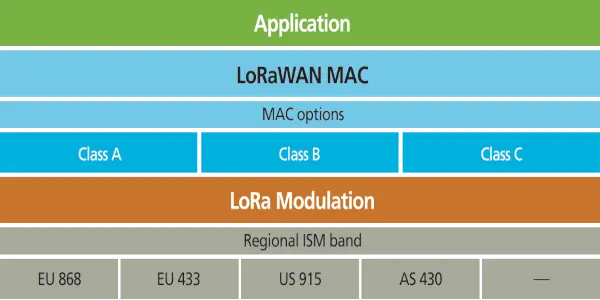
LoRaWAN: LoRa defines the physical radio layer, but higher network layers were still needed. LoRaWAN is one of several protocols developed to fill that gap. It is a cloud-based MAC-layer protocol that manages communication between LPWAN gateways and end-node devices, maintained by the LoRa Alliance.
OSI Model: the Open Systems Interconnection model (ISO/IEC 7498-1) is a reference framework for network protocols, created in 1980 by the International Organization for Standardization. It defines seven abstraction layers, each with distinct functions. This layered structure allows different protocols to interoperate by isolating specific responsibilities at each level [6].
MAC (Media Access Control): the set of mechanisms and protocols through which multiple devices on a network — computers, mobile phones, and others — coordinate access to a shared transmission medium, whether that's a copper cable, fiber optic, or, in wireless systems, an assigned frequency band.
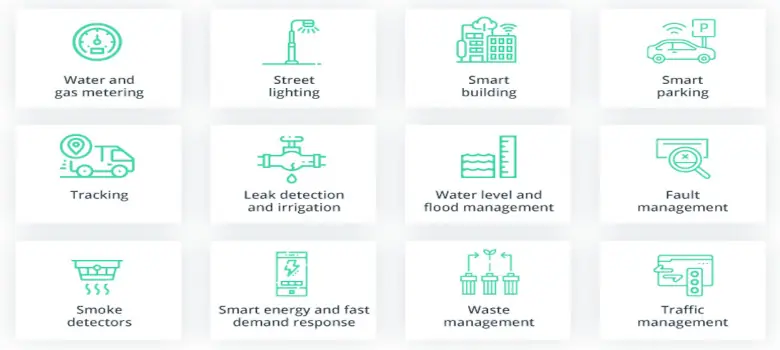
 LoRaWAN applications in urban environments and smart city infrastructure.
LoRa and LoRaWAN Applications for Cities
LoRa devices and the open LoRaWAN protocol unlock smart IoT applications that address some of the most pressing challenges cities face: energy management, natural resource conservation, pollution control, infrastructure efficiency, and disaster prevention, among others [7].
Hundreds of documented use cases now exist across smart cities, smart homes and buildings, precision agriculture, smart metering, and supply chain and logistics.
For smart cities specifically, the objectives are clear: improve performance, optimize resources, cut waste and costs, and raise quality of life for residents. LoRaWAN is particularly well suited to the applications cities need most:
- Environmental monitoring: LoRaWAN-based sensors track noise, air quality, and water pollution, keeping residents informed about local conditions. Parks and green spaces can be irrigated precisely by monitoring soil moisture in real time, reducing waste and unplanned maintenance.
- Parking management: spaces are monitored and managed more efficiently, generating incremental revenue and enabling operators to align pricing with actual demand patterns. Cities can also monitor no-parking zones to ensure unobstructed access for emergency vehicles.
- Public safety: IoT security devices report asset locations, sensors detect open doors, windows, or unexpected motion, and alerts are triggered automatically when smoke or fire is detected.
- Street lighting: cities can manage their energy footprint more effectively, detect outages or failed fixtures quickly, and improve safety for pedestrians, cyclists, and road users.
- Waste management: real-time fill-level data for waste containers enables reactive collection, prevents overflow, makes collection routes more efficient, and reduces unnecessary trips — saving fuel and cutting emissions.
- Workspace optimization: data on foot traffic, geolocation, and real-time space availability helps optimize office facilities, improve employee satisfaction, reinforce workplace security, and use physical resources more rationally.
References
- LoRa — Wikipedia
- What is LoRa? — Semtech
- Chirp Spread Spectrum — Wikipedia
- Internet of Things — Wikipedia
- LPWAN — Wikipedia
- OSI Model — Wikipedia
- Why LoRa Is the Best Option for Smart City and Smart Building Applications — Intellias
Johautt Hernández — jhernandez@innotica.net — LinkedIn