
Reflections on Building Ecosocialism
28 March 2016 by Moises Hernández
Gran Misión Vivienda Venezuela: Benefactor of the Disadvantaged or Incubator of a Consumerist Society?
At the start of the last century, Le Corbusier proposed housing solutions to address the urban migration crisis driven by industrialization. His ideas — standardizing construction processes and grounding residential design in the functional requirements of daily life — did more than solve a housing shortage. They standardized an entire typology of dwelling and, with it, a way of urban life. That movement became known as "modern architecture," and it gave rise to the "modern" lifestyle.
The concept of the machine à habiter — the house as a machine for living — defined in the first half of the twentieth century continues to drive housing solutions built today. Real-estate speculation, the scarcity of developable land, and high per-square-meter construction costs have all conspired to push anything resembling genuine quality of life out of reach for most. Elements of buen vivir get repositioned as luxury amenities — design features reserved for mid-to-high-income markets, priced and marketed accordingly.
Incomplete Solutions
Most housing built for lower-income populations addresses only the individual's or family unit's basic functions — the physiological needs of human beings:
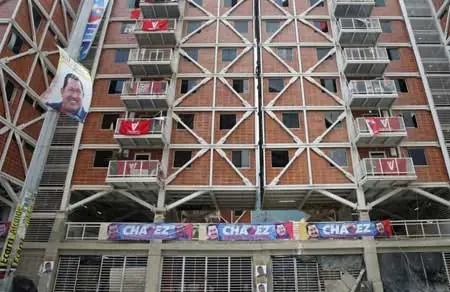 Social housing designed to cover basic physiological needs.
- Eating.
- Sleeping.
- Resting.
- Personal hygiene.
These needs define the design of any home. For social housing, however, they are often the only criteria applied. Needs that go beyond the physiological are left unaddressed:
- Sharing, affection, and love.
- Solitude and quiet.
- Conversation and listening.
- Communication and social connection.
- Recognition and a sense of identity.
- Appreciation of beauty.
- Contact with nature.
And broader dimensions of life — equally absent from most social housing design — including:
- Adaptability and flexibility over time.
- Mobility and access to transport.
- Creativity and productivity.
- Community life and social integration.
- Sustainability and resource efficiency.
These gaps produce sterile, marginal spaces throughout residential complexes — voids that are difficult to resolve after the fact. A handful of developments have attempted to incorporate some of these dimensions, but rarely all of them, leaving residents with a constrained quality of life and a limited experience of home.
Remedies Worse Than the Disease?
Housing designed only around basic functions tends to generate dysfunctional behaviors rooted in its own limitations. In many cases it simply does not fit the people living in it — people who are there not by choice but by necessity.
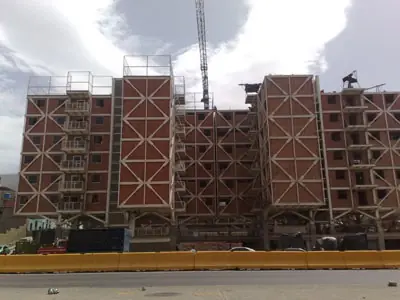 A residential complex illustrating the spatial constraints typical of social housing.
Common limitations include:
- Cramped floor plans with no realistic path to expansion.
- Inappropriate construction materials that create thermal imbalances.
- Repetitive, climate-blind design with no regional adaptation.
- No thermal or acoustic insulation, producing extreme temperature swings and high noise levels.
- No comfort zones inside or outside the unit.
- No safe, comfortable public spaces within the complex.
- Failure to account for fundamental environmental variables.
- Disruption of the productive and creative functions that rural or informal housing often supports.
- Poor accommodation of family mobility over time.
 Urban consequences of inadequate housing design.
These limitations compound into serious problems:
- Overcrowding.
- Extreme daytime heat and nighttime cold.
- Loss of identity, rootlessness, and no sense of belonging.
- Accelerated deterioration of building components and materials.
- Higher maintenance frequency and cost.
- Dependence on electric fans and air-conditioning units.
- Rising energy consumption.
- Breakdown of the family unit and growing individual isolation.
- Social exclusion and the erosion of community relationships.
- Greater exposure to environmental hazards and climate extremes.
- Reduced or lost productive and creative capacity within the household.
- Weakening of family bonds.
Social housing design must weigh construction costs carefully — but it must also account for the far greater cost of social, cultural, and environmental deterioration when those dimensions are ignored.
When adequate spaces for human needs are absent, people retreat to the only place that feels safe: typically their home, and ultimately their bedroom. That retreat progressively severs them from the social and family life around them. Other communication channels — television, phone, internet — create a sense of connection while actually deepening disconnection from the immediate environment. Over time, this erodes community participation and civic responsibility, feeding a growing perception of vulnerability and insecurity.
Reclaiming the Street
 The street as an abandoned public space, claimed by disorder.
The street — the quintessential public space — has been surrendered. Not only in Venezuela: citizens and civil authorities alike have allowed streets to become repositories for garbage, rubble, weeds, informal vendors, and encroaching commerce. Streetlights, utility cables, billboards, and parked vehicles accumulate without plan or order. Under those conditions, people have little reason — and little sense of safety — to step outside and simply talk with their neighbors.
We have inherited imported urban concepts that promote an individualist, consumerist way of life and are extraordinarily wasteful of resources and energy.
Implementing alternative socioeconomic models requires a physical environment that supports them. The modern city as it developed in Venezuela — as across Latin America — was shaped by the North American model: a framework built around individualism, standardization, social segregation, and consumption. The clearest symbol of that framework is the private automobile. American urban development was organized around the car and its road network, sometimes at the direct expense of citizens' basic needs.
If alternative models are to last, we need to understand the context we actually inhabit. More than 95% of Venezuela's population lives in cities and urban centers — all of them developing along the same conventional lines, shaped by imported models that preceded and reinforced a capitalist socioeconomic order.
We need to rethink, from the design and planning stage, what kind of city we want to build. That means identifying what human beings actually need in a context shaped by our own reality, with environmental balance at the center — supported by multifunctional environmental infrastructure that integrates productive cycles with ecological conditions and human expectations. The goal is a built environment that reinforces solidarity and human values rather than conditioning the lives of its inhabitants.
The housing solutions the Venezuelan government is building for the most disadvantaged communities through the Gran Misión Vivienda Venezuela (GMVV) urgently need to address these dimensions. There is a real risk of constructing millions of subsidized units without any framework capable of transforming how people live — without moving toward a way of life that is more equitable, sustainable, balanced, and shared.
The question of whether these housing solutions can deliver genuine quality of life — beyond a roof and a basic, dignified shelter — remains open.
The GMVV's enormous effort is not currently generating the physical and social conditions, inside homes, within complexes, or in public streets, needed to become a truly transformative force in Venezuelan society. For a real sense of socialism — understood as the practice of sharing — to emerge, the right spaces must exist.
Spaces for genuine social integration don't happen by decree. They must be designed for it: spaces for encounter, spaces for sharing. They need to grow from social housing designed not just for living, but for living together and producing together — where social experience is lived fully.