
Revit® as a BIM Tool
15 April 2020 by Lisgrett Bellorin
BIM (Building Information Modeling) is a collaborative methodology for the comprehensive creation and management of construction projects. Its core purpose is to centralize all project information in a single virtual model, where every stakeholder works together in real time.
The methodology spans the full building lifecycle — from conceptualization and design through construction, operation, and beyond.
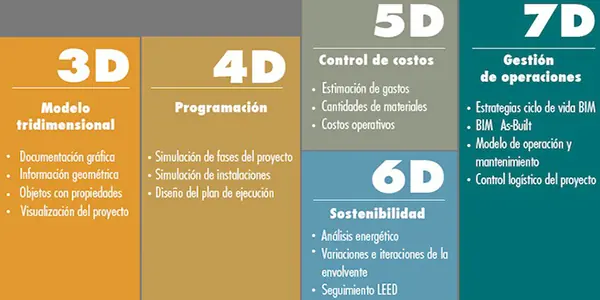
BIM represents an evolution beyond traditional drawing-based workflows. It layers geometric data (3D), time (4D), cost (5D), environmental performance (6D), and maintenance (7D) into a unified model. Implementing BIM means engaging with the entire building lifecycle: from initial concept through construction and long-term operation.
This approach brings every discipline into a shared workspace. Each specialist sees project changes in real time, which compresses delivery schedules and makes better use of assigned resources.
Putting BIM into practice requires modeling software that integrates all project tasks. At least four platforms are widely used: Revit (Autodesk), ArchiCAD (Graphisoft), Allplan (Nemetschek), and AECOsim Building Designer (Bentley Systems). Any of these can be adopted by project participants to support collaborative work and develop the building's digital model.
In any professional role, knowing your tools matters — but so does knowing why each tool exists, what it does well, and where its limits are. Most BIM platforms require formal training and sustained practice before a user can work at full proficiency.
 Autodesk Revit® working interface applied to a BIM project.
Autodesk Revit®
Autodesk Revit® is a design platform that generates complete project documentation quickly, within a coordinated environment. It supports multidisciplinary collaboration across the design process and allows teams to define distinct construction phases — useful for differentiating new construction from renovation work.
Revit® is one of the most widely adopted platforms among professionals working within BIM methodology. Beyond 3D digital modeling, it lets users attach project information and documentation directly to the model, enabling integrated planning, design, construction, and facility management.
Key Features of Revit®
Revit® is built for multidisciplinary, collaborative design. Its most significant capabilities include:
- Multidisciplinary workspace: Architects, engineers, operations staff, and other stakeholders can work simultaneously on the same model. Information is reused efficiently, and all changes are coordinated through the platform in real time.
- Full documentation suite: The platform supports the complete journey from conceptual design to construction drawings — including plans, sections, elevations, construction details, and quantity take-offs.
- Material and environmental library: An extensive library of architectural materials includes physical and environmental properties. Users can experiment with textures and finishes, run thermal calculations, and perform energy simulations.
- Coordination tools: Dedicated tools bring together all project disciplines, their documents, and associated data — giving project managers tighter control over architecture, structure, MEP systems, and other project details.
- Automatic shadow updates: Shadows recalculate automatically whenever structural changes, orientation adjustments, or other modifications affect how elements interact with light, making lighting impact immediately visible.
- Multi-angle analysis: The platform generates views from any angle, including hidden-line, silhouette, and shadow representations across multiple sections and perspectives.
- Interoperability: Revit® is compatible with other BIM-compliant platforms, ensuring smooth data exchange across the disciplines involved in a project.
 Building model developed in Revit® within a BIM workflow.
Tool Proficiency Is Not Enough
Revit® is a powerful platform for BIM implementation — but the quality of a digital model depends on far more than software skills. The principles that guide how the model is built matter just as much as the tool used to build it.
Mastering Revit®, or any other BIM platform, is a necessary condition — not a sufficient one. Understanding the BIM workflow is what actually enables successful methodology implementation on a construction project.
BIM applies across every project phase, from initial concept through eventual demolition. That makes it a sustained learning challenge, not only for professionals working today but for anyone entering the construction field in the future.
Focusing preparation solely on a specific software tool misses the point. The real investment is in understanding and developing the methodology itself.
Written by: Lisgrett Bellorin Project Engineer lbellorin@innotica.net