

SEO for Websites
12 August 2020 by Nixon Cedeño
SEO covers the practices aimed at improving a web page's position in organic search results for specific search queries.
It is a continuously growing discipline. Companies have come to recognize the strategic importance of appearing on the first page of search results, and SEO has established itself as one of the most effective and efficient ways to drive real results — while also building the right online positioning for a brand and its products.
From an internet marketing standpoint, SEO is never a standalone effort. It is part of — and deeply intertwined with — a broader set of actions, processes, and techniques that, when integrated, produce the search rankings you are after.
That's why solid SEO work requires close collaboration with both the marketing and IT departments. It demands a thorough understanding of the business, plus a willingness to modify, add, restructure, and optimize through iteration.
Results take time — typically the medium term. They depend on a coordinated set of efforts, and a proper measurement framework must be in place to track progress.
What Is SEO?
Search engine optimization (SEO) is the technical process of making structural and content changes to a website in order to improve its visibility in organic search results across different search engines. The term is used interchangeably with "search engine positioning" or "web optimization," though the acronym SEO is by far the most common.
The goal of SEO is visibility. Achieving it requires a strategy built around measurable objectives. As more users turn to the internet to communicate, research, and buy, any business that wants to grow online must earn a strong presence in search results.
The top five search results capture nearly 100% of all clicks. Within those results, roughly 90% of users click on organic (SEO) results, while 10% click on paid placements (PPC). Over the long term, SEO consistently delivers stronger returns.
Key benefits include:
- Greater visibility in search results.
- Higher click-through rates.
- More site traffic.
- Longer-lasting positions on the first page of results.
- More conversions — remembering that a conversion is any defined goal, not just a sale.
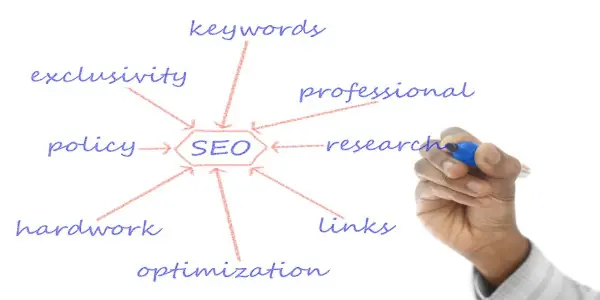
 A visual overview of the key elements in SEO positioning.
SEO Glossary
-
Keyword: the search term you want to rank for — the word or phrase a user types to find a product or service.
-
Long-tail keyword: a more specific search phrase with lower search volume but typically higher conversion rates.
-
Keyword density: how often a keyword appears relative to the total word count of a piece of content. A density of 2–3% is generally recommended.
-
Search engine: a software system designed to index and retrieve digital content — web pages, documents, videos, images, and more. The most widely used are Google, Bing, and Yahoo.
-
Algorithm: the set of rules a search engine uses to rank websites in its results, determining which page occupies each position.
-
Black Hat SEO: optimization techniques that violate Google's guidelines in an attempt to manipulate rankings.
-
White Hat SEO: optimization techniques that follow search engine guidelines and focus on sustainable, legitimate improvements.
-
Content: any element a user can read, watch, or listen to as part of their experience on a site — including text, images, audio, video, and animations.
-
Duplicate content: content that already exists elsewhere on the web. Search engines treat it as copied material and typically won't rank it.
-
Sitemap: a structured document listing all pages on a website, submitted to search engines to aid indexing.
-
Meta tags: HTML tags that help search engines interpret a page's content, contributing to better positioning in results.
-
Backlinks: inbound links pointing from other websites to your own.
-
Anchor text: the visible, clickable words in a hyperlink pointing to a web page.
-
Link building: the practice of acquiring inbound links to a website in order to improve its search rankings.
-
Impressions: the number of times a web page appears in a search engine's results pages.
-
Clicks: the number of times a user actually clicks on a page's link after it appears in search results.
-
CTR (click-through rate): the percentage of impressions that result in a click — a key efficiency metric for measuring how well a listing attracts users.
 Core metrics for evaluating the SEO performance of a website.
Takeaways
Digital presence matters — whether the goal is commercial growth or simply driving traffic to a specific page. Search positioning is central to that presence, which is exactly why sound SEO practices carry so much weight.
It goes beyond keywords. The quality and relevance of overall site content plays an equally important role in attracting and retaining visitors.
Search algorithms are updated regularly to prioritize high-quality content. Staying current with evolving SEO trends is therefore not optional — it's how you protect and build on the ground you've already gained.
Looking ahead to 2020, the following areas are shaping the SEO landscape [2]:
- Leveraging influencers as part of an SEO strategy.
- Prioritizing secure websites (HTTPS).
- Optimizing for voice search.
- Optimizing for mobile devices.
- Expanding multimedia content on web pages.
- Doubling down on content quality.
- Accounting for the growing role of artificial intelligence in search ranking.
- Not overlooking search engines beyond Google.
Nixon Cedeño, Full Stack Developer ncedeno@innotica.net · LinkedIn
References
- SEO: Optimización de webs para buscadores. Instituto de Nuevas Tecnologías (UNEWEB).
- SEO Trends for 2020 Every SEO Manager Should Know — IEBS School.
- SEO Best Practices for Optimizing Your Website — IMF Formación.