
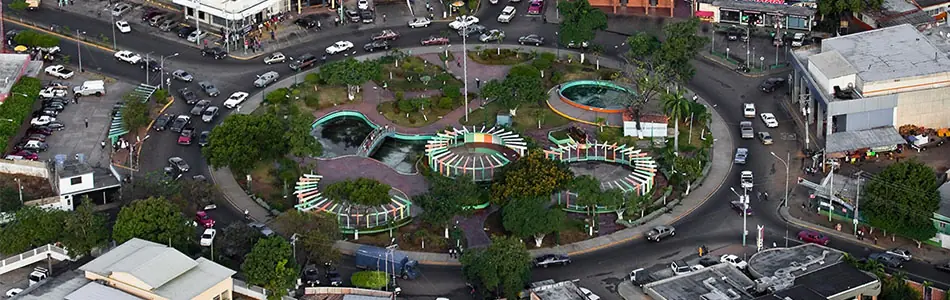
Urban Growth and the Demand for Resources
1 August 2016 by Moises Hernández
Today's society faces challenges that threaten to reshape the world as we know it. Technological advances are driving accelerated growth in what is already being called the "Information Age."
New communications technologies let people connect quickly and cheaply with almost any corner of the globe. The availability of rich, varied information — combined with an enormous capacity to generate, transmit, and store data — has triggered a technological revolution that is reshaping daily habits and human relationships alike.
Social networks have become a new platform for interaction, redefining how we relate to one another commercially, professionally, and economically.
 Connectivity is transforming the way we inhabit and manage cities.
Changing Habits, New Challenges
These societal shifts are showing up directly in consumption patterns. We need to communicate and express ourselves — and that requires being connected.
Staying connected demands significant financial investment: acquiring equipment, adapting to technology that never stops evolving. That investment is continuous and affects every level — personal, corporate, and institutional.
Society keeps transforming, and the city — our immediate environment — must transform with it. Adapting our built surroundings has become a priority goal: achieving maximum connectivity, creating interfaces that are both user-friendly and secure, and enabling richer interaction of all kinds.
This is undeniably a challenge, but it is also an opportunity to think, design, and build spaces conceived so that interaction among users is free, immediate, and spontaneous.
These opportunities exist at home, at work, and in public spaces. Our physical environment must adapt and reflect these shifts in how and through what means we communicate.
It must be recognizable and compatible, and it must be able to interact seamlessly with our virtual environment — always in sync, automatically.
Smart Cities and Connectivity
 Smart cities integrate technology and sustainability to optimize resource use.
These advances are reshaping how we understand the home, the workplace, and the city itself. Concepts like smart grids, smart cities, sustainable cities, virtual worlds, remote work, digital currencies, and Bitcoin are no longer theoretical — they define the road ahead.
Yet the development of all these technologies has driven a sharp increase in electricity demand. A connected society runs on energy, and energy carries a high price — economically and environmentally.
Globally, 71% of energy production relies on fossil fuels; only 14% comes from renewable sources and 15% from nuclear. The greenhouse gas emissions driving global warming are disrupting climate patterns worldwide.
Climate change stands as the single greatest threat facing humanity and ecosystems. CO₂ and other greenhouse gas emissions come from every major economic sector: energy production and supply leads at 26%, followed by industry at 19%, deforestation at 17%, agriculture at 14%, transport at 13%, residential and commercial buildings at 8%, and waste and wastewater treatment at the remaining 3%.
The Cost of Disproportionate Consumption
The seven wealthiest and most industrialized nations account for more than 72% of global emissions — a striking concentration of responsibility. Venezuela ranks 28th among emitting countries, with approximately 55,017 tonnes of carbon per year and a per-capita average of 1.67 tonnes annually.
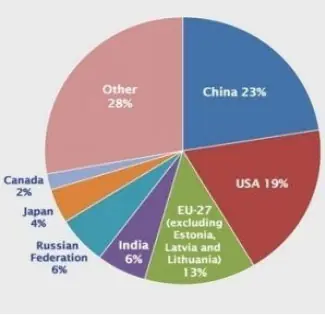 Distribution of carbon emissions by country based on global data.
Venezuela is also the largest per-capita energy consumer in Latin America, at 4,179 kWh per inhabitant — a figure that grows every year.
Urban population in Venezuela stands at 90%. Between 2000 and 2011 alone, the population grew by more than four million people. Cities struggle to absorb that pace of growth; inadequate infrastructure amplifies pressure on resources, particularly energy and water.
This dynamic, repeated across developing countries, exposes the linear city model — permanent growth in energy, materials, food, and water consumption — as neither viable nor sustainable. With natural resources finite, that model is overdue for a fundamental rethink.
Cities' appetite for energy is voracious. Within urban boundaries, the world consumes:
- 82% of all natural gas produced.
- 62% of all coal.
- 63% of all oil.
- 72% of all renewable energy (excluding biomass/firewood).
- 24% of all biomass.
Wealth, urbanization, and energy use grow together: the most affluent regions are the most urbanized and consume the most energy per capita. Against that backdrop, the city-as-linear-system concept is giving way to a circular model — one that minimizes inputs, reuses products and by-products, maximizes energy efficiency, and cuts emissions and waste.
In practice, emissions can be managed through public policy targeting:
- Energy use in buildings.
- Transportation modes.
- Emissions from urban growth patterns.
- Waste and wastewater management.
- Deforestation control.
The key to reducing emissions lies in how city managers govern energy demand. The lowest-cost, highest-impact emission reductions come from optimizing consumption in buildings, transport, and electricity supply.
A Final Reflection
Architects, planners, engineers, and developers bear significant responsibility for shaping the city. We have the capacity to meet this challenge — if we account for the changes already underway and the increasingly urgent demands being placed on us by society and by the climate.
What we need is a city capable of addressing the environmental, social, economic, and cultural challenges of sustainable development: a city that can transform itself to meet them.
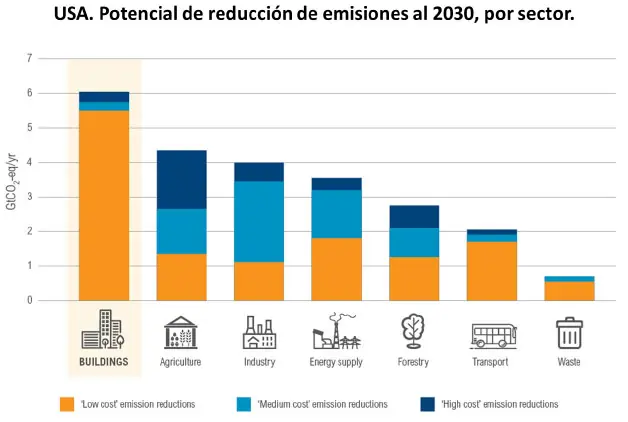 Sustainable urban design is essential to meeting today's environmental and social challenges.