

Sustainability and Energy Efficiency: A Response to the Crisis
15 February 2016 by Moises Hernández
A sustainable interior emerges from occupants' genuine concern for creating livable, healthy spaces that exist in harmony with the natural environment.
In these spaces, we prioritize natural and recycled materials — sourced locally whenever possible — with a clear emphasis on optimizing energy consumption, minimizing the environmental impact of design decisions, and reducing our ecological footprint as far as possible.
Growing alarm over environmental degradation has placed ecological design squarely in the spotlight. For several years now it has been one of the most influential design directions to follow — a lifestyle choice for some, and a significant business opportunity for many others.
The criteria shaping any project today go well beyond economics, technology, construction methods, or aesthetics alone. Soaring energy demand, rising energy costs, and the environmental consequences of a wasteful society — one increasingly subject to rigorous environmental regulation — are forcing a fundamental rethink of how we plan and design.
This shift moves operational and maintenance costs from an afterthought to a central priority, demanding efficient design with a holistic, integrated vision capable of meeting the environmental challenges ahead.
What's needed are long-term, comprehensive solutions where energy efficiency, sustainability, and common sense lead the way.
Defining Spaces
Interior spaces take shape as we come to understand the thermal, lighting, and occupancy requirements of each area. Spaces must be positioned according to the type of activity they support and the patterns of use they will see.
Scheduling, duration of occupancy, and activity type all influence where a given area should be located within the overall layout.
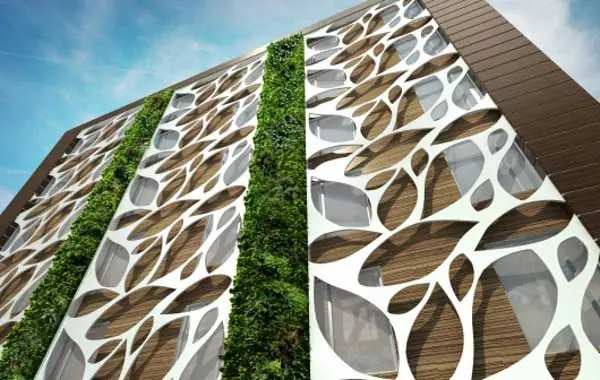 Example of an interior layout oriented toward energy efficiency.
A sound energy-efficient design strategy enables passive control measures that ensure optimal overall energy performance. At the same time, it creates the opportunity to layer in active control measures that improve quality of life without necessarily driving up energy consumption.
Ecological Design and Energy-Efficient Design Strategies
The sun is our primary energy source. Designing a sustainable space or interior begins with understanding the factors that govern how energy is captured and transferred through a building.
An effective strategy must be energy-efficient by design and account for the following parameters:
- Solar path
- Direct, diffuse, and reflected radiation
- Heat transfer mechanisms
- Thermal mass and heat capacity
- Natural convective phenomena
- Heat of vaporization
- Ground-level climate effects
- Thermal comfort
- Climate and site location
- Building form and orientation
- Passive solar gain
- Insulation and thermal mass
- Ventilation
- Ground-climate utilization
- Buffer spaces
- Evaporative cooling systems
Passive Control Systems
Every sustainable design must incorporate passive control solutions to keep energy consumption to a minimum. Key passive strategies include the following.
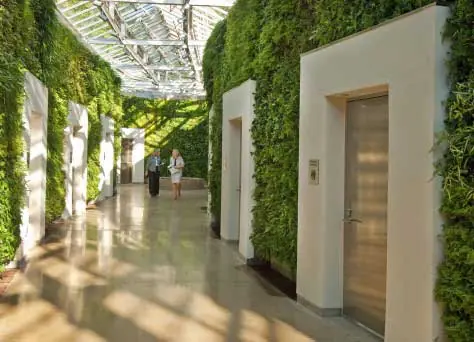 Natural ventilation and thermal mass applied in interior design.
-
Natural ventilation, used in combination with insulation, thermal mass, and solar shading, can significantly reduce or eliminate the need for mechanical air conditioning. Interior spaces should be designed to support effective natural ventilation and good air circulation throughout.
-
Interior layouts should be organized to maximize access to natural light through atriums, internal courtyards, and light wells — preferably open to the sky. The impact of daylighting depends on the proportions of the interior space and on the number, size, placement, and type of openings through which natural light enters.
-
Light, bright interior finishes reflect more light than dark, matte ones, and distribute it more effectively throughout the space. Ceiling and wall colors have a greater influence on light distribution than floor colors do. Light-colored surfaces can have nearly double the reflectivity of dark ones, translating to approximately 15% savings in artificial lighting energy consumption.
-
Green infrastructure integration is highly effective at regulating temperature and relative humidity in both exterior and interior environments. When woven into the overall design strategy from the outset, it delivers a range of benefits: it modifies the building's microclimate, saves energy, retains and redirects rainwater, cleans and cools the air, captures CO₂, promotes biodiversity, absorbs electromagnetic radiation, and — depending on the design — can also reduce noise levels.
Furniture, Office Equipment, and Appliances
Thoughtful layout of interior spaces and their systems, combined with appropriate furniture and equipment selection, can meaningfully reduce electrical energy demand in both residential and office settings — with direct benefits to quality of life.
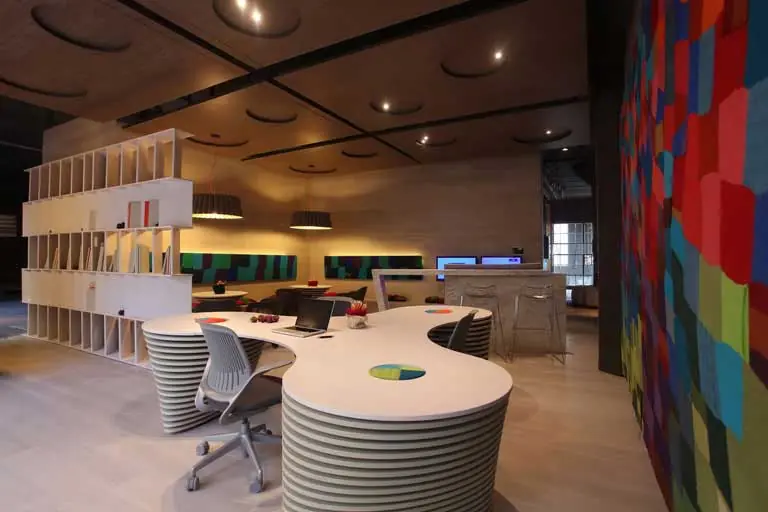 Furniture arrangement designed to take advantage of natural light through translucent partitions.
Interior walls and furniture placement should be planned to maximize natural light from windows and translucent enclosures. During the schematic design phase, it is essential to plan MEP requirements carefully — including equipment selection and positioning — to get the most out of available energy resources.
Everything described above can be further enhanced by deploying active control systems, which drive more efficient use of available resources and push energy consumption — along with maintenance costs — even lower.
Active Control Systems
Active control systems comprise a family of devices: sensors, detectors, controllers, and actuators. These systems must be considered from the earliest conceptual stages of design so that all subsystems — electrical, plumbing, mechanical, security, and others — can be fully integrated within the facility.
 All subsystems unified under a standard control protocol (KNX, BACnet, LonWorks, or IP).
Integration is the most critical phase. Once the characteristics of each subsystem have been defined, a single standard control protocol — LonWorks, KNX, BACnet, or IP — can be used to manage and monitor everything under one unified system.
This directly addresses one of the most persistent problems in modern buildings: monitoring silos. When lighting runs on one platform, HVAC on another, and pumping systems on a third, day-to-day operations become unnecessarily complex for maintenance staff.
Active control systems can cut lighting and HVAC energy consumption by up to 45%. They extend the service life of controlled equipment — pumps, climate systems, luminaires, and similar assets — by an average of 30%. They also reduce the staffing required for routine maintenance and enable predictive maintenance programs.
The concepts of sustainability and efficient resource use have been around for a long time. What's still missing is genuine leadership from the construction sector itself — developers, architects, and project designers who truly embed these principles into their work, moving them from passing trend to industry standard.