
The Tectonic Limit of BIM
8 July 2020 by Luis Fornez
The Sound of the Inevitable
It seems inevitable. I keep hearing Smith's words: "the sound of your inevitable death, Mr. Anderson." Like the Agent in The Matrix, BIM has spread fast — absorbing firms, industries, professionals, and universities at an accelerating pace.
Against that backdrop, it's worth asking: does Neo exist? Is there any approach that allows for something less automatic, less pre-scripted — some way to operate outside the matrix of BIM applications?
The question echoes Greg Lynn's essay [1] "Blob Tectonics, or Why Tectonics is Square and Topology is Groovy." Since then, cinematic references have been fair game in any text that puts the word "tectonics" in its title [2]. But the connection here goes beyond the title — and we'll keep returning to that claim.
As the subway rumbles closer and we tell ourselves it's unavoidable, consider: are we willing to set aside critical reflection on architectural production the moment a software update ships? (Think of the startup concept of a minimum viable product — are we settling for a minimum viable architecture?) And is the promised interoperability [3] really a genuine path toward software integration — one through which 21st-century architects might navigate the development of a new language, or an architecture that bears witness to a post-COVID-19 reality?
Of those three questions, the last is the hardest. It's not just broad — it demands a near-moral stance, the kind that has sunk more than one architectural essay. Let me reach for something biographical rather than cinematic.
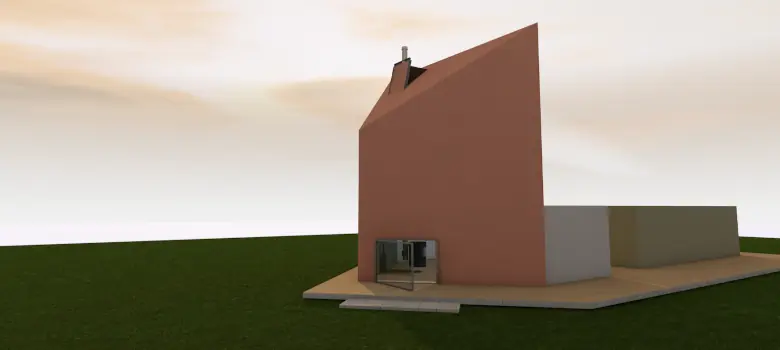
 Conceptual study of a rotated house as a challenge to parametric modeling in BIM.
The Raft
At the school where I trained as an architect, there is a shared conviction that the project itself is a research tool [4]. Even so, I've come to think "the project" is more powerful as a provocation. Either way, the idea works like a raft — and in a time of pandemic, rafts sound appealing.
After several years teaching BIM modeling at that same school, and after exploring integrations with various types of software and applications — both for data management and for non-linear design (that is, for handling form in the broadest possible sense) — one question keeps surfacing: what is the real implementation problem?
On the surface, everything appears resolved within a software matrix that makes a project's full lifecycle feel like an infallible logic. It seems as though no project can truly challenge this paradigm of 21st-century construction innovation. To put it plainly: only Agent Smith exists. Neo is nowhere to be found — or he's inside the matrix.
The Rotated House Project and the NEO House Challenge
Let's be honest: BIM modeling is compelling. Whether you're working in Revit or ArchiCAD, it's hard not to be genuinely impressed by the added value that comes with a complete view of architectural representation. That's compounded by growing software integration and an expanding ecosystem of online applications that let you import a full IFC model and bring every stakeholder — from design through construction to facility management — into a collaborative workflow.
Within that context, and borrowing Greg Lynn's framing from the essay cited earlier: where are the cracks? Where is the gap that invites questions about tectonic inquiry — when BIM pre-defines nearly everything through parametric combinations that are almost infinite in number but still structurally fixed?
Can third-party integrations alone solve it? Where is Neo? The following design proposal attempts to find that crack.
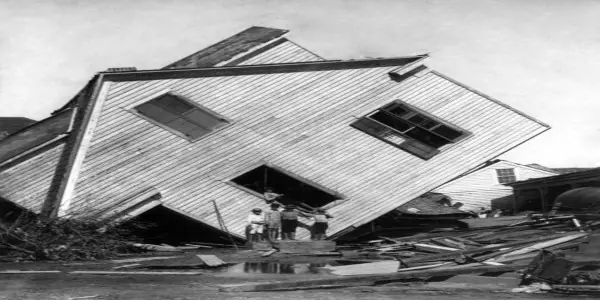
Rotated houses — or images of them — are a curiosity. They challenge our grasp of architectural space and visual language. Whether they are the product of a millionaire's eccentricity [5], a photographer's optical illusions on the hills of San Francisco [6], or the aftermath of hurricanes and tornadoes caught on film [7], the rotated house is genuinely disorienting — and genuinely interesting.
Conceiving a rotated house from scratch in a design environment means challenging the default configuration of parametric families and elements in BIM's CAD environment. The goal is to find that crack — that capacity, if it exists, to formulate an architectural proposal within a predetermined format that escapes the standard parametric framework.
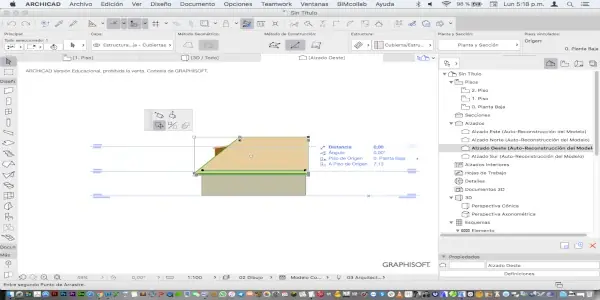 NEO House: every element conceived to be rotated 90 degrees while maintaining the BIM model's database logic.
In this small study, the NEO house was modeled with every element placed at its standard elevation and reference plane — but each element was conceived to be rotated, displacing it from its assigned floor level. In the database, the element still belongs to that level. This allows the house to be completed in its new 90-degree orientation using elements from the new floor created by the rotation, while every element remains part of a properly standardized BIM model.
Parametric objects, however, resist this search: the roof refused to be rotated and could only be manipulated after being converted to a form — a move that automatically freed it from its parametric constraints. The study concludes by adding skylights that, once the roof is rotated, can function as doors, along with two contextualizing objects to make the rotation legible. The intent is clear: to pose the challenge, and to invite readers and practitioners to locate the tectonic limit that lies beyond pre-parametrized objects and default tools.
My Name Is Neo
Back on the raft — or rising through the subway tunnel — we can say it plainly: any serious formal inquiry into these default tools could well be part of a larger project.
Not just a rotated-house study, but a collection of strategies for integrating third-party applications — a topic for a later chapter — alongside other approaches that explore the tectonic boundaries of BIM modeling environments. Why not do it in a way that's exploratory, even enjoyable?
Arq. Luis Fornez lfornez@gmail.com · LinkedIn
References
- Greg Lynn — Wikipedia
- Tectonics is defined as "the science or art of construction, both in relation to use and artistic design." In architecture it does not refer simply to the act of meeting a building's material requirements, but to the activity that frames construction as an art form. Arkiplus — Tectonics in Architecture
- BIM Interoperability — EspacioBIM
- One of the key texts on this subject — perhaps the most widely referenced — is by Ignasi de Solà-Morales. Differences — Google Books
- Upside-Down House in Germany — Pickchur
- Photographic Illusion in San Francisco — Insider
- Tilted House, Galveston Hurricane, 1900 — Wikimedia
