
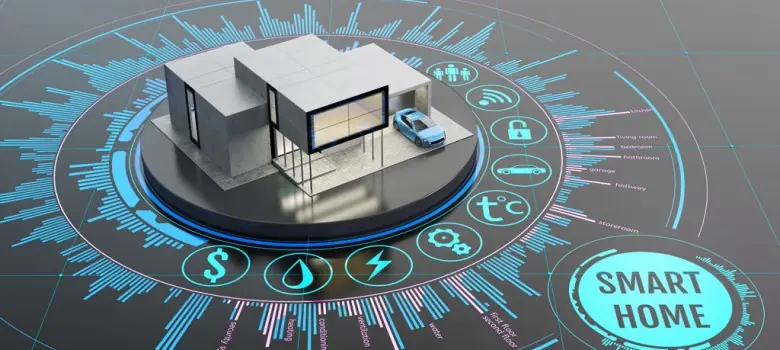
Wireless Technology for Home Automation
8 August 2017 by Adriana Endzeliz
Throughout history, people have worked to make their homes safer and more comfortable. As technology evolved, so did the systems we use to protect our families and property — and today, home automation sits at the center of that effort.
Home automation — or domotics — is the integration of technology (sensors, actuators, and related devices) to automate the systems that make up a residential building. The goal is typically energy management, improved security, better communications, and enhanced comfort.
For many homeowners, the first instinct is that all of this must be expensive. Wired installations do carry significant costs: not just the hardware itself, but the conduit work required, especially in buildings that are already occupied or have finished walls.
That's precisely where wireless technology becomes compelling. It simplifies installation and commissioning, allows the network to grow incrementally as needs evolve, and — crucially — lets you take your equipment with you if you move.
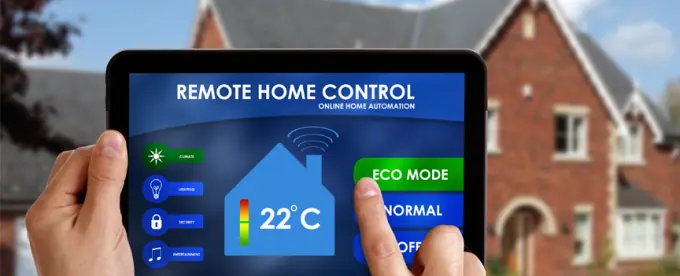 Integrated home automation systems in a residential environment.
The Main Wireless Protocols for Home Automation
Three protocols dominate the wireless home automation landscape: EnOcean, Z-Wave, and ZigBee.
1. EnOcean
EnOcean is a simple communication protocol — not yet formally standardized — best known for its ultra-low power consumption. Its sensors harvest ambient energy from the environment (movement, light, temperature differentials), which eliminates the need for batteries.
The protocol does not support routers, but it does support repeaters. However, any given message can only be repeated twice: the original is repeated once, and that repeat is forwarded once more. Under ideal conditions, EnOcean has a coverage range of 300 meters, a transmission speed of 25 kbit/s, and operates at 868 MHz.
2. Z-Wave
Z-Wave is another proprietary protocol, also not yet standardized. It defines two categories of devices:
- Controllers, which send commands to nodes on the network. Controllers break down further into installer controllers (used for network setup and maintenance) and bridge controllers (which act as protocol gateways — for example, converting Z-Wave to BACnet or Z-Wave to KNX).
- Slaves, which execute commands from controllers but do not exchange information independently.
Z-Wave's coverage range tops out at around 30 meters under ideal conditions, with transmission speeds of up to 40 kbit/s at 868 MHz. Its most significant drawback is relatively high power consumption.
3. ZigBee
ZigBee is both robust and straightforward. Its link and radio layers are based on the IEEE 802.15.4 standard, which gives it a solid technical foundation.
Its network topology can be star, tree, or mesh. Mesh is the most widely deployed configuration: multiple nodes interconnect within the same network, so if one node fails, traffic automatically reroutes through another path.
ZigBee devices fall into three roles:
- ZigBee Coordinator — manages the network and controls communication.
- ZigBee Router — handles interconnection between nodes.
- ZigBee End Device — can only receive data from its parent node, but powers down between interactions, which makes it highly energy-efficient.
ZigBee's routing capabilities and its robust network and application layers make it particularly attractive for more complex home automation deployments.
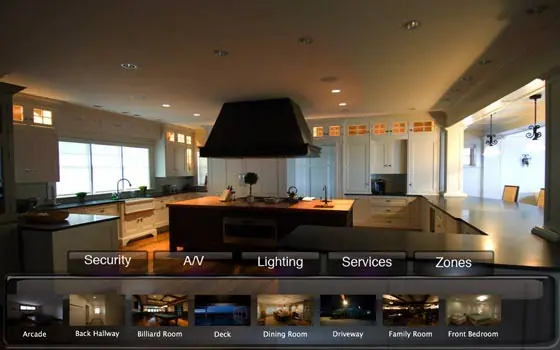 A comparison of the leading wireless protocols for home automation.
Choosing the Right Technology
The right wireless protocol depends on the specific communication requirements of your project. If you're approaching this as an enthusiast or DIY installer, do your research before committing to a platform — poorly understood technology leads to incorrect installation and network failures that are difficult to diagnose after the fact.
Wireless technologies are a solid choice for smaller spaces: apartments, small offices, or retrofit situations where running cable is impractical. They offer a relatively low cost of entry and straightforward installation.
That said, they are generally not recommended for large-scale installations. At that scale, the limitations in communication reliability and security become significant. For larger projects, open-standard wired communication technologies are the more appropriate path.